



Hyundai Venue vs Kona: Which Entry Hyundai SUV Fits First-Time Buyers?
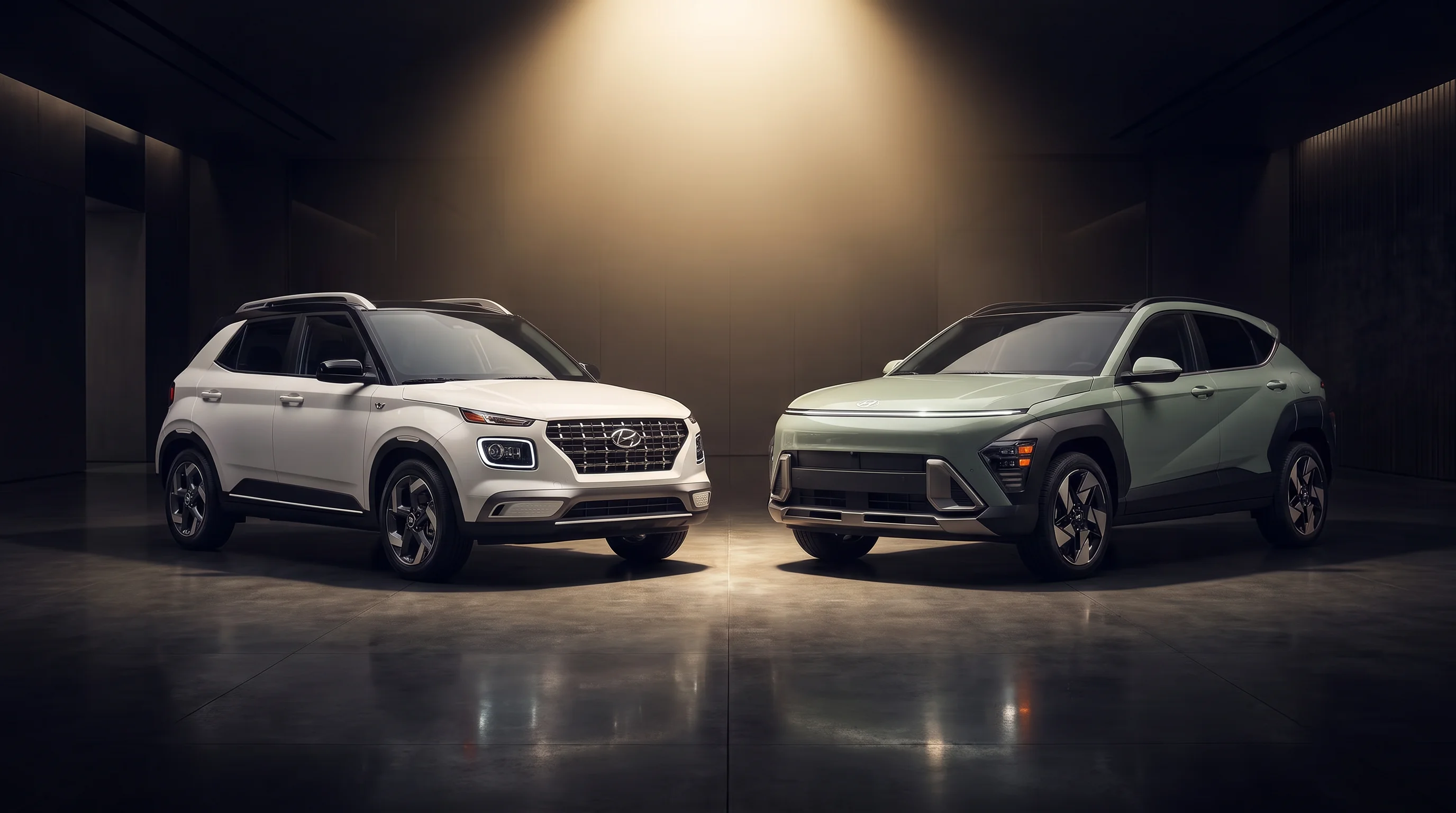
For first-time SUV buyers in Ontario, these two Hyundai crossovers solve different problems. The 2026 Venue is the lower-cost way into a new Hyundai SUV. It is also the easiest to park. The 2026 Kona gives you more room, more power, available all-wheel drive, and a top-tier crash-safety record. Neither one is the wrong answer. The right one depends on your priority: lowest entry cost, or the most capability you can grow into.
Venue vs Kona: The Short Answer
Choose the 2026 Hyundai Venue if your top priority is cost of entry, city maneuverability, and a simple SUV that does not ask much of your budget. The Venue is the least expensive new vehicle on sale in the United States. It took that spot after the Mitsubishi Mirage and Nissan Versa were discontinued.
Choose the 2026 Hyundai Kona if you need rear-seat space for adult passengers or car seats, want available all-wheel drive, or value the Kona’s IIHS TOP SAFETY PICK+ standing and its standard 12.3-inch touchscreen.
Ontario Hyundai stocks both. The Venue is a front-wheel-drive-only subcompact built around simplicity. The Kona is a larger crossover with two engines and four trims.
How the 2026 Venue and Kona Trim Lineups Compare
Hyundai simplified the Venue for 2026, dropping the previous Limited trim and consolidating the lineup into three configurations built on one powertrain.
2026 Hyundai Venue Trim Lineup
| Trim | Wheels | Seating Surfaces | Key Standard Content |
|---|---|---|---|
| SE | 15-inch alloy | Cloth | 8-inch touchscreen, wireless Apple CarPlay and Android Auto, 6-speaker audio, 4.2-inch gauge display |
| SEL | 17-inch alloy | Cloth | Adds heated front seats, wireless device charging, power sunroof, proximity key with push-button start, dual automatic climate control, second-row USB ports, Blind-Spot Collision Warning, Rear Cross-Traffic Collision Warning |
| SEL w/ 2-Tone Roof | 17-inch alloy | H-Tex leatherette | SEL content with a contrasting painted roof in place of the sunroof |
Every Venue uses the same 1.6L Smartstream four-cylinder. It produces 121 horsepower and 113 lb-ft of torque through an Intelligent Variable Transmission. Front-wheel drive is the only layout offered, per Hyundai’s published 2026 Venue specifications. The 8-inch touchscreen with wireless Apple CarPlay and Android Auto is standard across all three configurations, as is a six-speaker audio system and a 4.2-inch digital gauge display.
The Kona lineup is broader. For 2026, Hyundai retired the previous SEL, SEL Convenience, N Line, and N Line S grades and replaced them with SEL Sport and SEL Premium, producing a four-trim structure with a clear split between the two engines.
2026 Hyundai Kona Trim Lineup
| Trim | Engine | Horsepower | EPA-Estimated MPG (FWD) | Wheels | Key Standard Content |
|---|---|---|---|---|---|
| SE | 2.0L MPI | 147 hp | 29 city / 34 hwy / 31 combined | 17-inch | 12.3-inch touchscreen, Bluelink+, Blind-Spot Collision Warning, Rear Cross-Traffic Collision-Avoidance Assist, Safe Exit Warning, Smart Cruise Control with Stop and Go |
| SEL Sport | 2.0L MPI | 147 hp | 28 city / 35 hwy / 31 combined | 18-inch black finish | Adds heated front seats, wireless device charging, dual automatic climate control, second-row air vents |
| SEL Premium | 1.6L Turbo-GDI | 190 hp | 26 city / 31 hwy / 28 combined | 19-inch | Adds 8-speed automatic transmission, H-Tex leatherette seating, 8-way power driver seat, 12.3-inch digital instrument cluster |
| Limited | 1.6L Turbo-GDI | 190 hp | 26 city / 31 hwy / 28 combined | 19-inch | Adds Bose 8-speaker premium audio, Surround View Monitor, Blind-Spot View Monitor, ventilated front seats, power sunroof, Remote Smart Parking Assist |
EPA-estimated fuel economy figures are for comparison purposes only. Your actual mileage will vary depending on driving conditions, how you drive and maintain your vehicle, battery age/condition, and other factors.
Driver-assistance and advanced safety systems are supplemental aids and are not substitutes for safe and attentive driving. Availability, operation, and effectiveness vary by trim and equipment and depend on factors including road, weather, traffic, and vehicle condition. Always keep your hands on the wheel and your eyes on the road. See your owner’s manual for system limitations and details.
Both 2.0L trims use an Atkinson-cycle engine making 132 lb-ft of torque through an Intelligent Variable Transmission. The turbocharged SEL Premium and Limited make 195 lb-ft across a broad 1,700 to 4,500 rpm band, paired with an 8-speed automatic and paddle shifters. HTRAC all-wheel drive is available on all four trims.
That split matters for a first-time buyer. The turbocharged engine is not reserved for the top Limited trim. It arrives one step earlier, on the SEL Premium. The 12.3-inch digital instrument cluster arrives there too. Shoppers who want the stronger powertrain do not have to buy the most expensive Kona.
Which 2026 Hyundai SUV Offers More Cargo and Passenger Space?
The Kona is meaningfully larger inside, and the gap is widest exactly where a growing household feels it.
| Specification | 2026 Hyundai Kona | 2026 Hyundai Venue |
|---|---|---|
| Seating capacity | 5 | 5 |
| Cargo volume, behind rear seats | 25.5 cu ft | 18.7 cu ft |
| Cargo volume, rear seats folded | 63.7 cu ft | 31.9 cu ft |
| Rear legroom | 38.2 in | 34.3 in |
| Front legroom | 41.7 in | 41.3 in |
| Front shoulder room | 56.8 in | 53.9 in |
| Overall length | 171.3 in | 159.1 in |
| Wheelbase | 104.7 in | 99.2 in |
The 3.9-inch rear legroom advantage is what adult passengers and rear-facing car seats notice first, and the extra front shoulder room is what makes the Kona’s cabin feel more open rather than merely longer.
The Venue answers with a smaller footprint. That is a genuine advantage, not a consolation. Its 16.6-foot curb-to-curb turning diameter makes it easier to park and easier to thread through tight lots. Its upright roofline also delivers 39.4 inches of front headroom, slightly more than the Kona Limited offers. For a first-time buyer driving mostly around Ontario, Fontana, and Rancho Cucamonga, that compactness is a daily benefit. Browse our full Hyundai lineup to see how both models are equipped on the lot.
How the 2026 Venue and Kona Drive
The Venue uses a single powertrain across every trim. The 1.6L four-cylinder produces 121 horsepower at 6,300 rpm and 113 lb-ft at 4,500 rpm through an Intelligent Variable Transmission. Curb weight starts around 2,612 pounds, so it feels light and willing around town. On steep highway grades, or with five occupants aboard, it asks for more throttle than the Kona does.
The Kona’s base 2.0L delivers 147 horsepower at 6,200 rpm and 132 lb-ft at 4,500 rpm, which is enough for confident freeway merging without moving up a tier. The 1.6L turbo on the SEL Premium and Limited produces 190 horsepower at 6,000 rpm and 195 lb-ft from 1,700 rpm, and the 8-speed automatic suits it better than a continuously variable unit would.
Kona models with HTRAC all-wheel drive upgrade from a torsion-beam rear to an independent multi-link rear suspension. That improves composure over rough pavement. Front-wheel-drive Kona models use the torsion beam. The Venue uses a coupled torsion-beam rear axle across the lineup, and does not offer all-wheel drive in any configuration.
Which 2026 Hyundai Gets Better Fuel Economy?
Both are efficient. The Venue holds one EPA-estimated figure across its entire lineup. The Kona’s numbers move with engine and drivetrain.
There is no efficiency penalty for choosing a higher Venue trim. The front-wheel-drive Kona SE matches the Venue’s 31 EPA-estimated combined MPG and adds a highway advantage. Choosing all-wheel drive or the turbocharged engine trades some of that back.
For a first-time buyer commuting on the 10 or the 60, the Kona SE front-wheel drive and the Venue are close enough on fuel that efficiency alone should not decide this. Space, drivetrain, and safety standing are the more useful tiebreakers.
| Configuration | EPA-Estimated MPG (city / highway / combined) |
|---|---|
| Venue — all trims (FWD) | 29 / 33 / 31 |
| Kona SE (FWD) | 29 / 34 / 31 |
| Kona SE (AWD) | 27 / 29 / 28 |
| Kona SEL Sport (FWD) | 28 / 35 / 31 |
| Kona SEL Sport (AWD) | 26 / 29 / 27 |
| Kona SEL Premium and Limited (FWD) | 26 / 31 / 28 |
| Kona SEL Premium and Limited (AWD) | 25 / 28 / 26 |
EPA-estimated fuel economy figures are for comparison purposes only. Your actual mileage will vary depending on driving conditions, how you drive and maintain your vehicle, battery age/condition, and other factors.
Comparing Technology in the 2026 Venue and Kona
The clearest technology gap between these two is screen size. Every 2026 Kona carries a 12.3-inch touchscreen, including the base SE. Every 2026 Venue carries an 8-inch touchscreen. Both run wireless Apple CarPlay and Android Auto as standard equipment. Both also include Bluetooth hands-free calling, dual front USB charge ports, and steering-wheel audio controls.
| Technology Feature | 2026 Hyundai Kona | 2026 Hyundai Venue |
|---|---|---|
| Touchscreen display | 12.3-inch, all trims | 8-inch, all trims |
| Wireless Apple CarPlay and Android Auto | Standard, all trims | Standard, all trims |
| Digital gauge display | 4.2-inch; 12.3-inch from SEL Premium up | 4.2-inch, all trims |
| Wireless device charging | Standard from SEL Sport up | Standard on SEL and SEL w/ 2-Tone Roof |
| Premium audio | Bose 8-speaker on Limited | 6-speaker audio, all trims |
Where the Kona Pulls Ahead
Bluelink+ connected services are standard across the Kona lineup. Wireless device charging arrives at the SEL Sport trim. The SEL Premium adds the 12.3-inch digital instrument cluster. The Limited adds a Bose premium audio system with eight speakers, a Surround View Monitor, and ventilated front seats.
Where the Venue Holds Its Own
The Venue is better equipped than its screen size suggests. This is where the comparison is most often misstated. The Venue SEL includes wireless device charging, heated front seats, and dual automatic temperature control as standard equipment. It also adds second-row USB ports, proximity key entry with push-button start, a power sunroof, and a leather-wrapped steering wheel. The SEL with 2-Tone Roof swaps the sunroof for a contrasting painted roof and H-Tex leatherette seating surfaces. A first-time buyer comparing a Venue SEL against a Kona SE is not trading away convenience features to save money.
Safety Features and Crash-Test Ratings
Both vehicles carry Hyundai SmartSense active safety equipment as standard, and both earned a 4-star overall NHTSA rating with 5 stars in side-impact protection and 4 stars in frontal crash and rollover testing.
Standard on Both the 2026 Venue and the 2026 Kona
Forward Collision-Avoidance Assist
With Pedestrian Detection, standard on every trim of both vehicles.
Lane Keeping Assist
Helps keep the vehicle centered within detected lane markings.
Driver Attention Warning
Monitors driving patterns and prompts a break when attention drops.
Rear Occupant Alert
Reminds the driver to check the back seat after the vehicle is parked.
Six Airbags
Dual front, front seat-mounted side-impact, and side-curtain airbags with rollover sensors.
Stability and Braking Systems
Anti-lock braking, Electronic Stability Control with Traction Control, and Vehicle Stability Management.
Driver-assistance and advanced safety systems are supplemental aids and are not substitutes for safe and attentive driving. Availability, operation, and effectiveness vary by trim and equipment and depend on factors including road, weather, traffic, and vehicle condition. Always keep your hands on the wheel and your eyes on the road. See your owner’s manual for system limitations and details.
How the Driver-Assist Suites Differ
The Kona standardizes more of the sensor suite across every trim. Blind-Spot Collision Warning, Rear Cross-Traffic Collision-Avoidance Assist, Safe Exit Warning, Lane Following Assist, and Smart Cruise Control with Stop and Go are standard on all four Kona trims. On the Venue, Blind-Spot Collision Warning and Rear Cross-Traffic Collision Warning are standard on the SEL and SEL with 2-Tone Roof. They are not offered on the Venue SE. A Venue SEL therefore carries blind-spot and cross-traffic protection; a Venue SE does not.
Crash-Test Results
The Kona Limited extends furthest, adding a Surround View Monitor, a Blind-Spot View Monitor that projects a side-camera feed into the digital cluster, Parking Distance Warning for forward, side, and reverse, Parking Collision-Avoidance Assist in reverse, and Remote Smart Parking Assist.
On third-party crash testing, the two separate. The 2026 Hyundai Kona is an IIHS TOP SAFETY PICK+, the Institute’s highest award tier. It is one of several Hyundai models on the 2026 IIHS small SUV award list. The 2026 Hyundai Venue holds no IIHS award. That is because the Institute has not finished testing the vehicle, not because the Venue failed a test. The Venue did earn the Institute’s highest rating of Good in the small overlap front test.
Driver-assistance and advanced safety systems are supplemental aids and are not substitutes for safe and attentive driving. Availability, operation, and effectiveness vary by trim and equipment and depend on factors including road, weather, traffic, and vehicle condition. Always keep your hands on the wheel and your eyes on the road. See your owner’s manual for system limitations and details.
Warranty Coverage on the 2026 Venue and Kona
Both vehicles carry identical factory coverage, which removes warranty from the decision entirely:
- 10-Year / 100,000-Mile Powertrain Limited Warranty
- 5-Year / 60,000-Mile New Vehicle Limited Warranty
- 7-Year / Unlimited-Mile Anti-Perforation Warranty
- 5-Year / Unlimited-Mile 24/7 Roadside Assistance
This information is provided for general educational purposes only and does not constitute legal advice. Warranty coverage depends on the specific terms of your vehicle’s warranty agreement. Consult your owner’s manual or a qualified legal professional for guidance on your individual situation.
Frequently Asked Questions
Is the 2026 Hyundai Kona worth stepping up to from the 2026 Venue?
It depends on what you need from the vehicle. The Kona adds 3.9 inches of rear legroom, 6.8 more cubic feet of cargo space behind the second row, a standard 12.3-inch touchscreen, available all-wheel drive, an available 190-horsepower turbocharged engine, and an IIHS TOP SAFETY PICK+ rating. If you regularly carry rear-seat passengers or want all-wheel drive, the Kona earns the step up. If you drive mostly solo or with one passenger in city traffic and want the lowest cost of entry, the Venue delivers most of the same convenience equipment in a smaller package.
Driver-assistance and advanced safety systems are supplemental aids and are not substitutes for safe and attentive driving. Availability, operation, and effectiveness vary by trim and equipment and depend on factors including road, weather, traffic, and vehicle condition. Always keep your hands on the wheel and your eyes on the road. See your owner’s manual for system limitations and details.
Does the 2026 Hyundai Venue offer all-wheel drive?
No. The 2026 Hyundai Venue is front-wheel drive across all three configurations: SE, SEL, and SEL with 2-Tone Roof. If you want all-wheel drive, the 2026 Hyundai Kona offers HTRAC all-wheel drive as an option on all four of its trims.
Which one gets better fuel economy for daily commuting?
The 2026 Venue delivers a consistent EPA-estimated 29 city / 33 highway / 31 combined MPG across every trim. The front-wheel-drive 2026 Kona SE matches that EPA-estimated 31 combined rating and improves on it at 34 MPG highway. Kona all-wheel-drive and turbocharged configurations return lower figures.
EPA-estimated fuel economy figures are for comparison purposes only. Your actual mileage will vary depending on driving conditions, how you drive and maintain your vehicle, battery age/condition, and other factors.
Which crossover is better suited for small families?
The Kona. With 38.2 inches of rear legroom against the Venue’s 34.3 inches, and 25.5 cubic feet of cargo behind the second row against 18.7, the Kona accommodates car seats and strollers with less compromise. Its IIHS TOP SAFETY PICK+ rating also gives it the stronger third-party safety record of the two.
Driver-assistance and advanced safety systems are supplemental aids and are not substitutes for safe and attentive driving. Availability, operation, and effectiveness vary by trim and equipment and depend on factors including road, weather, traffic, and vehicle condition. Always keep your hands on the wheel and your eyes on the road. See your owner’s manual for system limitations and details.
The Verdict: Which Entry Hyundai SUV Fits You?
The 2026 Hyundai Venue is the better choice if cost of entry is the deciding factor. It suits drivers who stay mostly urban and suburban and rarely carry rear-seat passengers. It is the least expensive new vehicle in the country and it is easy to park. In SEL trim it carries heated seats, wireless charging, a sunroof, and blind-spot protection.
The 2026 Hyundai Kona is the better choice if you need the back seat to work for adults or car seats. It also wins if you want all-wheel drive or the strongest safety credentials in the pair. Its 12.3-inch touchscreen is standard on every trim. The turbocharged engine arrives at the SEL Premium, not only at the top of the range.
Our team at Ontario Hyundai can put both in front of you on the same visit, which is the fastest way to settle this. Drivers from Ontario, Fontana, Corona, Rancho Cucamonga, and Eastvale are welcome to compare the two side by side and test drive each. For more breakdowns, explore more Hyundai model research.
Disclaimers
EPA-estimated fuel economy figures are for comparison purposes only. Your actual mileage will vary depending on driving conditions, how you drive and maintain your vehicle, battery age/condition, and other factors.
Driver-assistance and advanced safety systems are supplemental aids and are not substitutes for safe and attentive driving. Availability, operation, and effectiveness vary by trim and equipment and depend on factors including road, weather, traffic, and vehicle condition. Always keep your hands on the wheel and your eyes on the road. See your owner’s manual for system limitations and details.
This information is provided for general educational purposes only and does not constitute legal advice. Warranty coverage depends on the specific terms of your vehicle’s warranty agreement. Consult your owner’s manual or a qualified legal professional for guidance on your individual situation.