



2026 Hyundai IONIQ 5 vs Tesla Model Y: How They Compare for Ontario Drivers
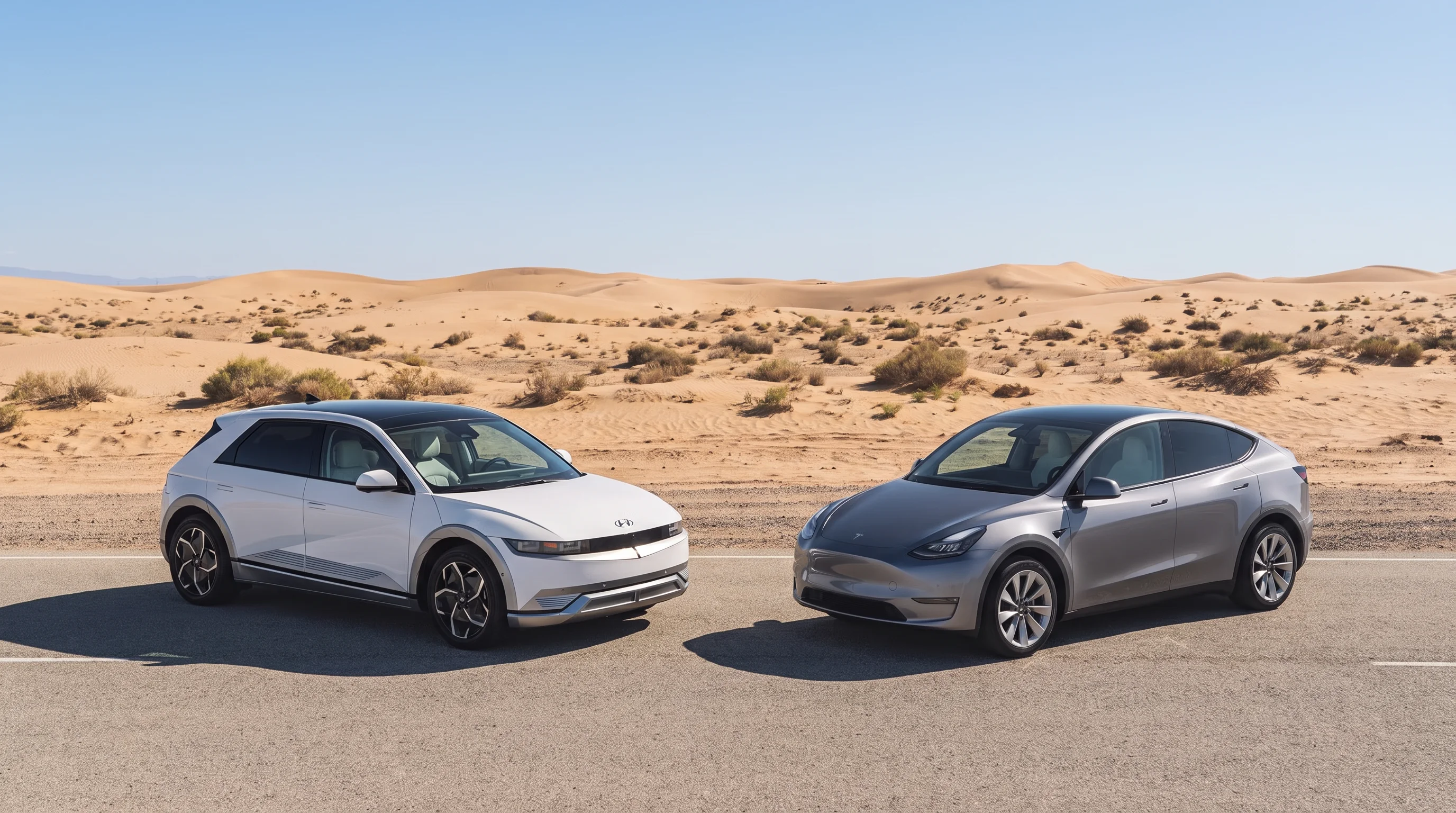
The 2026 Hyundai IONIQ 5 makes a strong case against the 2026 Tesla Model Y. It costs less to start, charges at a higher peak rate, and carries powertrain and battery coverage that runs two years longer. It also now plugs into Tesla Superchargers without an adapter.
The Model Y answers with more cargo room and longer range in its higher trims. Here is how the two actually compare.
At a Glance: IONIQ 5 vs Model Y
Here are the figures that decide most shopping decisions, side by side.
| Specification | 2026 Hyundai IONIQ 5 | 2026 Tesla Model Y |
|---|---|---|
| Starting MSRP | $36,600 MSRP | $41,380 MSRP |
| EPA-Estimated Range (maximum) | 318 miles (long-range RWD) | 357 miles (Premium RWD) |
| EPA-Estimated Range (all-wheel drive) | 269 miles (Limited AWD) | 327 miles (Premium AWD) |
| Maximum DC fast-charging power | 350 kW | 250 kW |
| Charging port | Native NACS, plus CCS adapter | Native NACS |
| Apple CarPlay and Android Auto | Standard, wireless | Not supported as of August 2026 |
| Maximum cargo volume | 58.5 cubic feet | 76 cubic feet |
| Basic warranty | 5 years / 60,000 miles | 4 years / 50,000 miles |
| Powertrain and battery warranty | 10 years / 100,000 miles | 8 years / 100,000–120,000 miles by configuration |
Pricing and the Full 2026 Trim Lineup
Hyundai cut IONIQ 5 prices for 2026. The reductions run from $7,600 to $9,800 per trim, announced by Hyundai Motor America as a repositioning of the lineup after the federal EV tax credit ended.
The result: the IONIQ 5 now opens at $36,600 MSRP. The Tesla Model Y opens at $41,380 MSRP. That is roughly $5,000 in Hyundai’s favor at the entry point, and it requires no tax paperwork, no income qualification, and no eligibility check. It is built into the sticker.
Every 2026 IONIQ 5 Trim and Price
The lineup spans five trim names across eight configurations. The value tends to concentrate in the middle of it rather than at the top.
| 2026 IONIQ 5 Configuration | Starting MSRP | Horsepower | EPA-Estimated Range |
|---|---|---|---|
| SE Standard Range RWD | $36,600 MSRP | 168 hp | 245 miles |
| SE RWD | $39,100 MSRP | 225 hp | 318 miles |
| SEL RWD | $41,400 MSRP | 225 hp | 318 miles |
| SE AWD | $42,600 MSRP | 320 hp | 290 miles |
| Limited RWD | $46,675 MSRP | 225 hp | 318 miles |
| XRT AWD | $47,875 MSRP | 320 hp | 259 miles |
| Limited AWD | $50,575 MSRP | 320 hp | 269 miles |
SEL AWD is also offered. For a full walkthrough of what separates each configuration, see our 2026 IONIQ 5 trim levels and pricing guide.
Manufacturer’s Suggested Retail Price (MSRP) for new vehicles includes manufacturer and distributor options and delivery, process and handling fees, which may be subject to change at any time. MSRP excludes taxes, title, license and dealer installed options, accessories, fees and charges. MSRP is not the dealer advertised price. Dealer price will vary. The dealer sets the final price.
Charging: Where the IONIQ 5 Changed the Math
Supercharger Access Without Buying a Tesla
For years the strongest argument for buying a Tesla had nothing to do with the car. It was the Supercharger network. That argument no longer applies.
Every 2026 IONIQ 5 ships with a factory-installed NACS charging port. It plugs directly into Tesla Superchargers, no adapter required. Hyundai owners get the same network access Tesla owners have, plus CCS stations and the rest of the public charging landscape.
Peak Charging Power
The IONIQ 5 runs an 800-volt architecture that accepts up to 350 kW of DC fast-charging power. Tesla lists a 250 kW ceiling for the Model Y. On a 350 kW charger, the IONIQ 5 goes from 10% to 80% in approximately 20 minutes.
It is worth being precise here. Tesla’s charging curve is excellent, and the Model Y adds up to 169 to 182 miles in 15 minutes depending on configuration. In miles-added terms, the two are close. Hyundai’s advantage is the higher peak power ceiling, combined with network access it did not previously have.
At home, a 240-volt Level 2 charge takes roughly seven hours and 20 minutes. Our IONIQ 5 range and charging times page breaks down real-world scenarios in more detail.
EPA-estimated fuel economy figures are for comparison purposes only. Your actual mileage will vary depending on driving conditions, how you drive and maintain your vehicle, battery age/condition, and other factors.
Range and Efficiency
The Model Y holds a real range advantage in its higher trims. Pretending otherwise would not serve anyone shopping seriously.
What the IONIQ 5 offers instead is a long-range configuration at a lower price. The SE at $39,100 MSRP delivers an EPA-estimated 318 miles. Full range figures by trim are published in Hyundai’s official specifications.
EPA-estimated fuel economy figures are for comparison purposes only. Your actual mileage will vary depending on driving conditions, how you drive and maintain your vehicle, battery age/condition, and other factors.
Performance and Driving Experience
Powertrain by Configuration
| Configuration | Motor Layout | Horsepower | Torque | 0–60 mph |
|---|---|---|---|---|
| SE Standard Range RWD | Single rear motor | 168 hp | 258 lb-ft | Approximately 8.5 seconds |
| Long-range RWD | Single rear motor | 225 hp | 258 lb-ft | 7.4 seconds |
| Long-range AWD | Dual motor, one per axle | 320 hp | 446 lb-ft | 4.6 seconds |
Tesla does not publish horsepower or torque figures for the Model Y, so a direct output comparison is not possible. On acceleration, the Premium AWD matches the IONIQ 5 Limited AWD at 4.6 seconds.
Ride Quality
This is where the IONIQ 5 separates itself. A 118.1-inch wheelbase, independent suspension front and rear, and stabilizer bars at both ends produce a settled ride over rough pavement. Reviewers consistently note the Model Y’s firmer setup, though the 2026 refresh softened it.
Towing
If towing matters, one configuration handles it. Hyundai rates the AWD XRT for up to 2,700 pounds when equipped with the factory tow hitch, and does not recommend towing with rear-wheel-drive IONIQ 5 models.
Maximum towing and payload capacity figures are based on properly equipped vehicles and vary by configuration. Do not exceed any weight rating. See your owner’s manual and the vehicle’s door-jamb label for specific capacities.
Cargo and Passenger Space
This is the Model Y’s clearest win, and the gap is wider than it first appears.
| Measurement | 2026 Hyundai IONIQ 5 | 2026 Tesla Model Y |
|---|---|---|
| Cargo behind rear seats | 26.3 cubic feet | 30.2 cubic feet |
| Maximum cargo volume | 58.5 cubic feet | 76 cubic feet |
| Front trunk | 0.85 cubic feet | Included in total cargo figure |
| Front legroom | 41.7 inches | Not published by Tesla |
| Seating capacity | 5 | 5 (up to 7 on Premium AWD) |
Where the IONIQ 5 competes is in how the space is arranged. The flat floor made possible by the E-GMP platform means the center rear seat has real foot space instead of a driveline hump. Rear passengers get 39.4 inches of legroom.
Technology and Interior Controls
Smartphone Integration
Wireless Apple CarPlay and Android Auto are standard on every 2026 IONIQ 5. Both display across a 12.3-inch touchscreen, paired with a 12.3-inch digital instrument cluster.
As of August 2026, no Tesla model supports either system natively. Tesla has announced that CarPlay is coming through an over-the-air update, but no release date has been confirmed. No Android Auto rollout has been announced at all.
Controls You Can Use Without Looking
The IONIQ 5 keeps physical controls for the functions drivers reach for most. Audio gets knobs and buttons. Climate gets its own separate panel. Neither is buried in a touchscreen menu.
Premium Audio
Higher trims add a Bose premium audio system with eight speakers and a dedicated subwoofer.
Parking and Visibility
An augmented reality head-up display, a surround-view monitor, and Remote Smart Parking Assist 2 are available.
Vehicle-to-Load Power
Vehicle-to-Load capability lets the IONIQ 5 power external devices directly from the vehicle.
Bluelink+ connected services handle remote locking, climate preconditioning, and over-the-air software updates.
Safety
The 2026 Hyundai IONIQ 5 earned a TOP SAFETY PICK+ award from the Insurance Institute for Highway Safety. That is the organization’s highest designation. IIHS tightened its criteria for 2026, now requiring stronger rear-passenger protection and better-performing crash avoidance systems.
Driver-assistance content on higher trims includes the following:
- Highway Driving Assist 2
- Smart Cruise Control with Stop & Go
- Blind-Spot View Monitor, which shows a live camera feed in the instrument cluster
- Rear Cross-Traffic Collision-Avoidance Assist
Driver-assistance and advanced safety systems are supplemental aids and are not substitutes for safe and attentive driving. Availability, operation, and effectiveness vary by trim and equipment and depend on factors including road, weather, traffic, and vehicle condition. Always keep your hands on the wheel and your eyes on the road. See your owner’s manual for system limitations and details.
Warranty Coverage
| Coverage | 2026 Hyundai IONIQ 5 | 2026 Tesla Model Y |
|---|---|---|
| New Vehicle Limited (Basic) | 5 years / 60,000 miles | 4 years / 50,000 miles |
| Powertrain | 10 years / 100,000 miles | Covered under battery and drive unit coverage |
| High-voltage battery | 10 years / 100,000 miles | 8 years / 100,000–120,000 miles by configuration |
Hyundai’s powertrain and battery coverage runs a full decade. That is two years longer than Tesla’s battery and drive unit warranty. Basic coverage extends a year and 10,000 miles further as well.
This information is provided for general educational purposes only and does not constitute legal advice. Warranty coverage depends on the specific terms of your vehicle’s warranty agreement. Consult your owner’s manual or a qualified legal professional for guidance on your individual situation.
Frequently Asked Questions
Does the 2026 IONIQ 5 charge faster than the Tesla Model Y?
The IONIQ 5 accepts a higher peak charging rate — up to 350 kW on its 800-volt architecture, against the 250 kW maximum Tesla lists for the Model Y. On a 350 kW charger it goes from 10% to 80% in approximately 20 minutes. In practical miles-added terms the two are closer than that gap suggests, since Tesla’s charging curve is strong. The larger change for 2026 is that the IONIQ 5 ships with a native NACS port and can use Tesla Superchargers directly.
How much torque does the IONIQ 5 deliver?
The dual-motor all-wheel-drive IONIQ 5 produces 446 lb-ft of torque alongside 320 horsepower, available instantly from a standstill. Rear-wheel-drive long-range models deliver 258 lb-ft. Tesla does not publish torque figures for the Model Y, so a direct comparison is not available.
Does the Hyundai IONIQ 5 support Apple CarPlay and Android Auto?
Yes — wireless Apple CarPlay and Android Auto are standard across the 2026 IONIQ 5 lineup, shown on the 12.3-inch central touchscreen. As of August 2026, Tesla vehicles including the Model Y do not support either natively. Tesla has said CarPlay is coming via software update, but no date has been confirmed, and no Android Auto support has been announced.
How do the warranties compare?
Every 2026 IONIQ 5 carries a 10-year/100,000-mile powertrain and high-voltage battery warranty plus a 5-year/60,000-mile New Vehicle Limited Warranty. Tesla provides a 4-year/50,000-mile basic warranty and an 8-year/100,000- to 120,000-mile battery and drive unit warranty depending on configuration.
Can the 2026 IONIQ 5 tow?
Yes, in one configuration. Hyundai rates the AWD XRT for up to 2,700 pounds with the factory tow hitch installed. Hyundai does not recommend towing with rear-wheel-drive IONIQ 5 models.
Which One Fits Your Driveway?
If maximum range or maximum cargo volume decides it for you, the Model Y earns honest consideration. It leads on both.
The IONIQ 5 is the stronger buy on five counts: a lower entry price, the longest warranty coverage in the segment, standard smartphone integration, physical controls you can operate without looking, and Supercharger access that no longer requires buying a Tesla.
Ontario Hyundai stocks 2026 IONIQ 5 trims and configurations for drivers across Ontario, Fontana, Rancho Cucamonga, Corona, Eastvale, and Puente Hills. Our team can walk you through the trim differences and charging options in person.
You can also explore the rest of our electric and hybrid lineup, or see how another Hyundai EV stacks up in our 2026 IONIQ 9 vs Kia EV9 comparison.
Disclaimers
Manufacturer’s Suggested Retail Price (MSRP) for new vehicles includes manufacturer and distributor options and delivery, process and handling fees, which may be subject to change at any time. MSRP excludes taxes, title, license and dealer installed options, accessories, fees and charges. MSRP is not the dealer advertised price. Dealer price will vary. The dealer sets the final price.
EPA-estimated fuel economy figures are for comparison purposes only. Your actual mileage will vary depending on driving conditions, how you drive and maintain your vehicle, battery age/condition, and other factors.
Maximum towing and payload capacity figures are based on properly equipped vehicles and vary by configuration. Do not exceed any weight rating. See your owner’s manual and the vehicle’s door-jamb label for specific capacities.
Driver-assistance and advanced safety systems are supplemental aids and are not substitutes for safe and attentive driving. Availability, operation, and effectiveness vary by trim and equipment and depend on factors including road, weather, traffic, and vehicle condition. Always keep your hands on the wheel and your eyes on the road. See your owner’s manual for system limitations and details.
This information is provided for general educational purposes only and does not constitute legal advice. Warranty coverage depends on the specific terms of your vehicle’s warranty agreement. Consult your owner’s manual or a qualified legal professional for guidance on your individual situation.