



Your Complete Vehicle Service FAQ at Ontario Hyundai
Keeping up with routine maintenance is one of the best ways to protect your investment and stay safe on the road. Whether you drive a new Hyundai or a pre-owned vehicle, understanding what goes into a full service — and when to schedule one — helps you make informed decisions about your vehicle’s care. Below, our Service Department answers the most common maintenance questions from drivers across Ontario, Fontana, Rancho Cucamonga, and the surrounding Inland Empire.
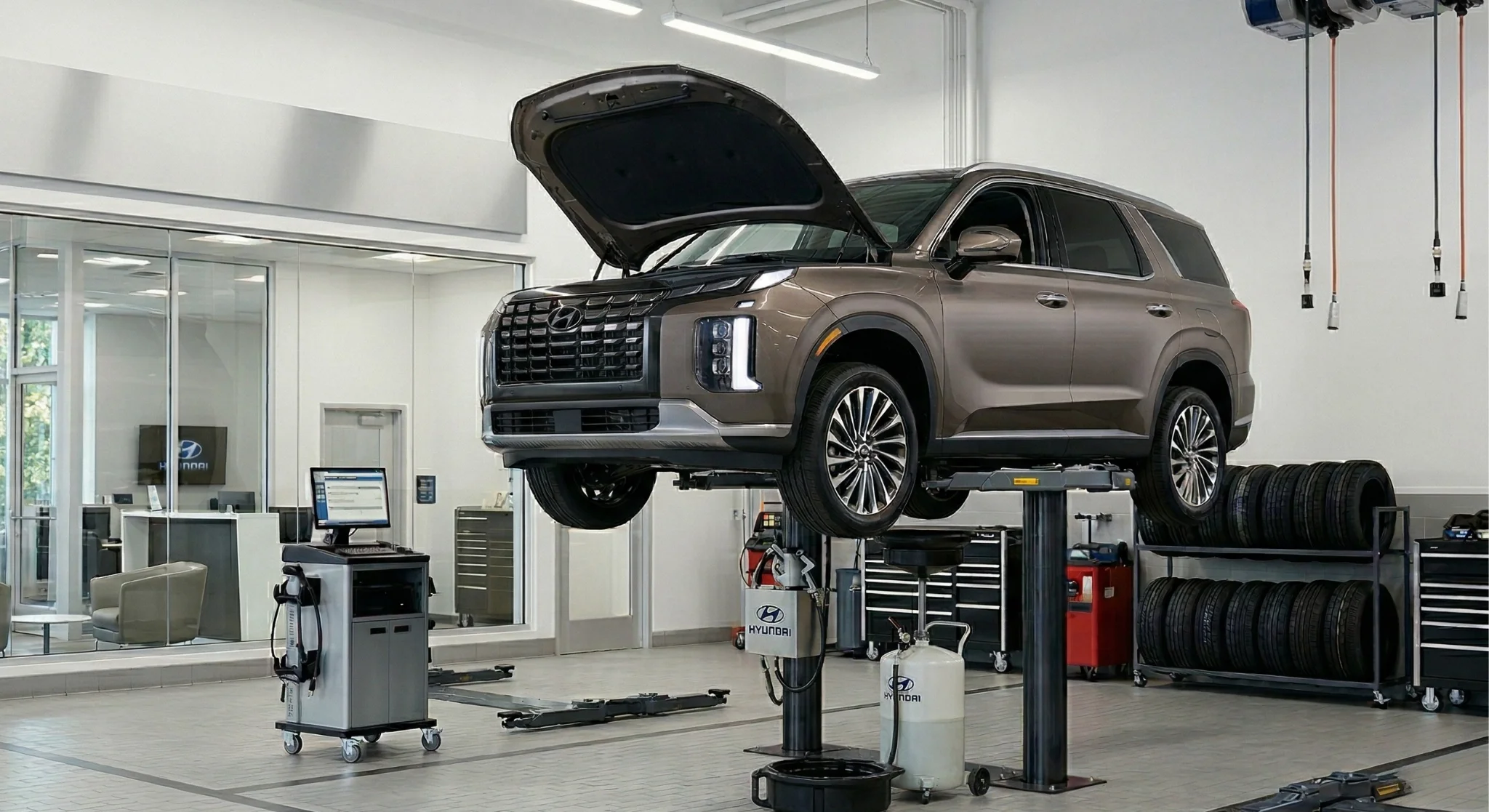
What Does a Full Vehicle Service Include?
A full vehicle service is a comprehensive inspection and maintenance routine designed to keep your car running safely and efficiently. At Ontario Hyundai, our factory-trained technicians perform a thorough examination of your vehicle’s key systems, including the engine, brakes, fluids, tires, battery, and electrical components. The goal is to catch wear or developing issues early — before they become costly repairs or safety concerns.
A standard full service typically includes an oil and filter change, a complete fluid check and top-up (coolant, brake fluid, transmission fluid, and power steering fluid), brake inspection, tire evaluation, battery and electrical system check, belt and hose inspection, a diagnostic scan of onboard computer systems, and a safety check covering suspension, steering, exhaust, and wipers.
Having your full service performed at Ontario Hyundai means benefiting from technicians trained specifically on Hyundai vehicles, using genuine Hyundai parts available through our Parts Department. This helps maintain your vehicle’s integrity and warranty coverage.
How Often Should I Change My Synthetic Motor Oil?
Synthetic motor oil lubricates engine components, reduces friction, and protects against wear. Compared to conventional oils, synthetic oils offer superior stability under extreme temperatures and resist breakdown over longer periods, keeping your engine running efficiently between service visits.
Hyundai’s official maintenance schedule recommends an oil and filter change every 7,500 miles or approximately every six months under normal driving conditions. Vehicles using synthetic oil under normal conditions can often extend this interval to 7,500–10,000 miles, depending on the model. Always follow the schedule in your owner’s manual.
Recommended Oil Change Intervals
| Driving Conditions | Oil Type | Recommended Interval |
|---|---|---|
| Normal (highway, moderate climate) | Full Synthetic | Every 7,500–10,000 miles |
| Normal | Conventional | Every 3,000–5,000 miles |
| Severe (stop-and-go, short trips, towing, extreme heat) | Full Synthetic | Every 3,000–5,000 miles |
Source: Hyundai USA Maintenance Schedule (hyundaiusa.com). Intervals may vary by model and year. Always consult your owner’s manual for the specific recommendation for your vehicle.
For drivers in the Ontario and Rancho Cucamonga area, where temperatures can swing from cool mornings to hot afternoons throughout much of the year, synthetic oil’s enhanced thermal stability is particularly beneficial. If you frequently make short trips, drive in stop-and-go traffic, or tow heavy loads around the Inland Empire, you may fall under Hyundai’s severe conditions schedule. Vehicles equipped with oil-life monitoring systems provide real-time alerts adjusted to your actual driving patterns.
What Are Common Signs My Brakes Need Service?
Recognizing early warning signs of brake issues is essential for safety and preventing expensive repairs. Here are the most common symptoms to watch for and what they typically indicate:
Brake Warning Signs at a Glance
| Symptom | Likely Cause | Recommended Action |
|---|---|---|
| High-pitched squealing | Brake pads wearing thin (wear sensor alert) | Schedule inspection soon |
| Harsh grinding noise | Pads worn to metal — metal-on-rotor contact | Service immediately — rotor damage risk |
| Soft or spongy pedal / pedal sinks to floor | Air or moisture in brake fluid, leak, or master cylinder issue | Service immediately — safety critical |
| Vehicle pulls to one side when braking | Uneven brake wear, brake line leak, or suspension issue | Schedule inspection |
| Vibration or pulsation in pedal | Warped rotors | Professional resurfacing or replacement needed |
| Brake pad thickness less than 1/4 inch (visible through wheel spokes) | Normal wear approaching minimum safe thickness | Schedule pad replacement |
For drivers in Ontario, Fontana, Eastvale, and Corona who frequently encounter stop-and-go traffic along the I-10 and I-15 corridors, brake wear can accelerate, making regular inspections even more important. If you notice any of these signs, schedule a brake inspection promptly.
How Often Should I Rotate and Balance My Tires?
Regular tire rotation and balancing are essential for maintaining your vehicle’s handling, safety, and ride quality. Rotation involves systematically moving tires between positions on the vehicle to promote even tread wear, while balancing ensures each tire and wheel assembly spins smoothly without causing vibrations.
Tire Rotation Intervals by Drivetrain
| Drivetrain Type | Recommended Rotation Interval |
|---|---|
| Front-Wheel Drive (FWD) | Every 5,000–7,500 miles |
| Rear-Wheel Drive (RWD) | Every 5,000–7,500 miles |
| All-Wheel Drive (AWD) | Every 3,000–5,000 miles |
Source: Hyundai USA dealer service recommendations and owner’s manual guidelines. Hyundai’s standard maintenance schedule bundles tire rotation with the 7,500-mile service interval. Always consult your owner’s manual for your specific model.
Balancing is typically performed alongside rotations or whenever vibrations are detected at highway speeds. Neglecting tire care can lead to premature tire replacement, reduced fuel efficiency, and compromised braking performance. For drivers across the Rancho Cucamonga, Corona, and Puente Hills area, regular tire maintenance helps keep your Hyundai handling safely in all conditions.
How Does Maintenance Differ for Electric and Hybrid Vehicles?
Electric vehicles and hybrids have fundamentally different maintenance needs compared to gasoline-powered cars. Since EVs do not use internal combustion engines, many routine tasks are eliminated entirely — there are no oil changes, fuel filter replacements, spark plug changes, or exhaust system repairs. EVs also have fewer moving parts overall, resulting in less wear on components traditionally prone to failure.
Brake maintenance also differs. Electric and hybrid vehicles use regenerative braking, which recovers energy to recharge the battery while slowing the vehicle. This significantly reduces reliance on traditional friction brakes, extending brake pad service intervals. Regular brake system inspections still remain important for safety.
EV and hybrid owners should pay particular attention to battery health and the charging system. Hyundai covers hybrid and EV high-voltage batteries for 10 years or 100,000 miles, with a guarantee that capacity will not drop below 70% during the warranty period. While gradual capacity degradation is a normal part of the battery lifecycle, professional evaluation may be needed as the battery ages beyond warranty coverage.
EV maintenance places greater emphasis on electronic diagnostics and software updates. Manufacturers frequently release over-the-air updates, and authorized service centers use specialized tools to diagnose electrical components. For Hyundai EV and hybrid owners in Ontario and the surrounding Inland Empire, our Service Department is equipped with the specialized training and diagnostic tools required for electrified vehicles.
Does My 2026 Hyundai Come With Free Maintenance?
Starting with the 2026 model year, Hyundai has discontinued the Hyundai Complimentary Maintenance (HCM) program that previously covered oil changes, tire rotations, and multi-point inspections for the first three years or 36,000 miles of ownership. If you purchased a 2020–2025 Hyundai, your complimentary maintenance coverage remains in effect — the change only applies to 2026 and newer models.
For 2026 Hyundai owners, routine maintenance costs are now the owner’s responsibility from day one. Hyundai does offer optional pre-paid maintenance plans that allow you to lock in service pricing at the time of purchase. Ask our Service Department about available pre-paid options for your specific model.
The rest of Hyundai’s America’s Best Warranty remains unchanged and continues to be one of the strongest in the industry:
2026 Hyundai Warranty Coverage Summary
| Coverage | Duration | Key Details |
|---|---|---|
| New Vehicle Limited Warranty | 5 years / 60,000 miles | Bumper-to-bumper coverage against manufacturing defects |
| Powertrain Limited Warranty | 10 years / 100,000 miles | Original owner only; covers engine, transmission, drivetrain |
| Powertrain (Subsequent Owner) | 5 years / 60,000 miles | Reduced coverage transfers with vehicle sale |
| Hybrid/EV Battery Warranty | 10 years / 100,000 miles | 70% capacity guarantee; covers high-voltage battery and components |
| Anti-Perforation Warranty | 7 years / unlimited miles | Covers rust-through of body panels |
| Federal Emissions Warranty | 8 years / 80,000 miles | Major emissions components |
| 24-Hour Roadside Assistance | 5 years / unlimited miles | Towing, battery jump-start, flat tire, lockout service |
| Complimentary Maintenance | Discontinued for 2026 | Pre-paid plans available; 2020–2025 models retain original coverage |
Source: Hyundai USA — America’s Best Warranty (hyundaiusa.com/assurance), 2026 Hyundai Owner’s Handbook & Warranty Information. Warranty terms summarized for general information. See your Owner’s Handbook or visit hyundaiusa.com for complete terms, conditions, and exclusions.
Staying current with your recommended maintenance schedule is the best way to preserve these warranty protections and keep your Hyundai running reliably for years to come.
Can I Use an Independent Mechanic Without Voiding My Warranty?
Under the federal Magnuson-Moss Warranty Act, your Hyundai warranty remains valid even if you choose to have routine maintenance or repairs performed by an independent mechanic. You are not required to visit a Hyundai dealership for routine service to maintain your warranty coverage.
However, it is important that any work performed meets Hyundai’s maintenance specifications as outlined in your owner’s manual, and that you keep detailed records of all service performed — including receipts and documentation of parts used. If a warranty claim arises, Hyundai may request proof that proper maintenance was completed on schedule.
While independent shops can handle routine maintenance, authorized Hyundai dealerships offer the advantage of factory-trained technicians, access to Hyundai-specific diagnostic tools, and genuine Hyundai parts — all of which help ensure work is performed to the manufacturer’s exact specifications. This can be especially important for newer vehicles under warranty and for Hyundai’s electrified models, which require specialized equipment.
Schedule Your Next Service at Ontario Hyundai
For Hyundai owners across Ontario, Fontana, Eastvale, Rancho Cucamonga, Corona, and the Puente Hills area — our Service Department is ready to help maintain your vehicle with precision and care.
Or call our Service Department directly: 888-348-4964
Sources
Maintenance interval and warranty information referenced in this article is sourced from: Hyundai USA Official Maintenance Schedule (hyundaiusa.com/maintenance-schedule), 2026 Hyundai Owner’s Handbook & Warranty Information (hyundaiusa.com), Hyundai USA America’s Best Warranty (hyundaiusa.com/assurance/america-best-warranty), and Hyundai USA Service & Warranty (service.hyundaiusa.com/warranty). All data current as of April 2026.
Disclaimer: Maintenance intervals, service recommendations, and warranty terms described on this page are provided for general informational purposes only. Specific maintenance schedules vary by model, model year, driving conditions, and vehicle history. Always consult your Hyundai Owner’s Manual for the exact service schedule for your vehicle. Warranty coverage is subject to terms, conditions, limitations, and exclusions as described in your Hyundai Owner’s Handbook & Warranty Information booklet. Visit hyundaiusa.com or contact Ontario Hyundai’s Service Department for the most current warranty details applicable to your vehicle.