



2026 Hyundai Tucson vs. 2026 Toyota RAV4: Which Hybrid SUV Wins for Ontario Drivers?
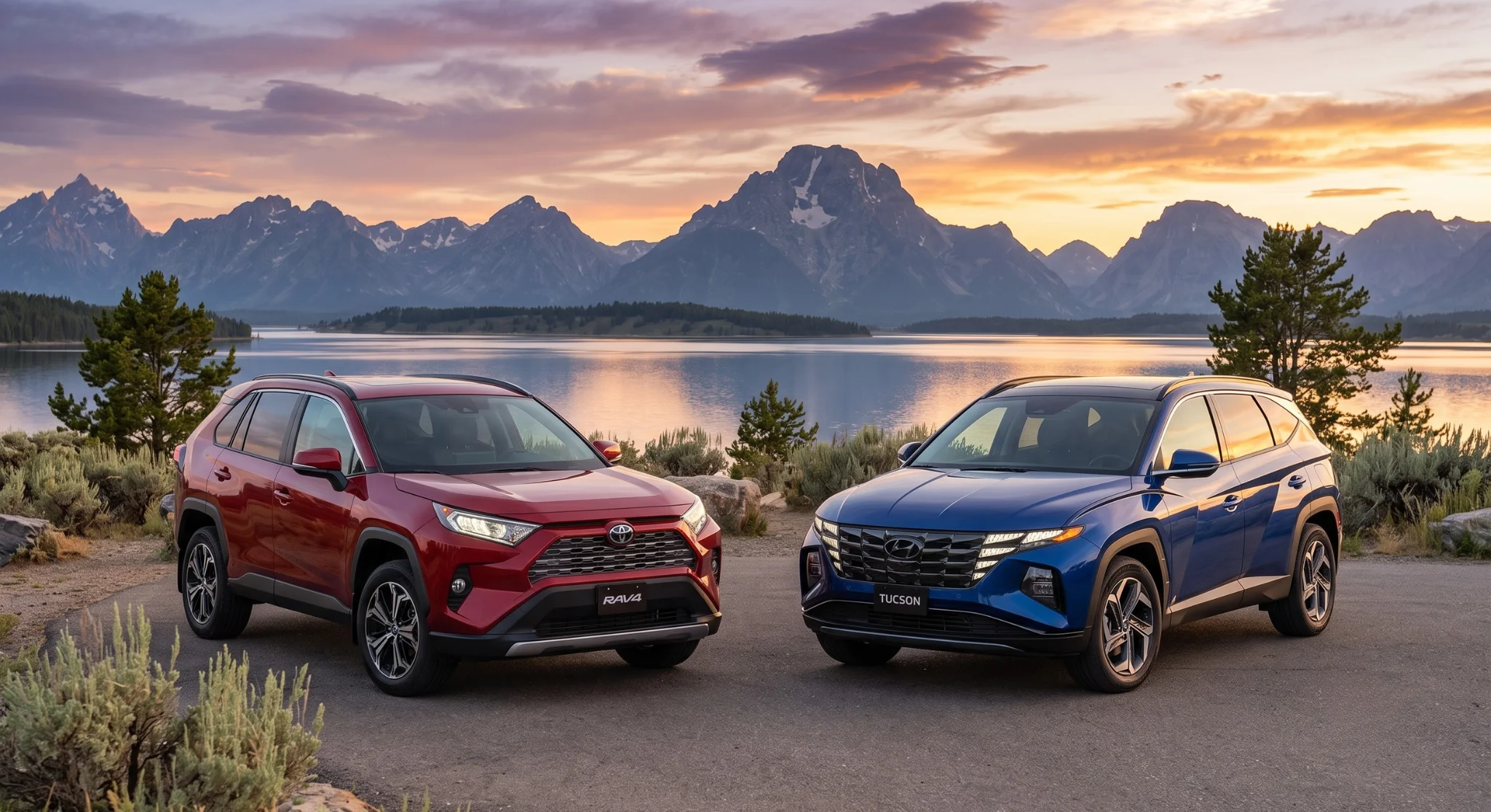
When you’re cross-shopping compact hybrid crossovers in the Inland Empire, two names rise to the top: the 2026 Hyundai Tucson and the all-new, sixth-generation 2026 Toyota RAV4. Both are five-seat hybrids built for school runs, I-10 commutes, and weekend trips. This head-to-head lays out the verified numbers — price, efficiency, space, tech, safety, and warranty — so you can see exactly where each SUV leads. We sell the Tucson, and we think it makes the stronger all-around case for most local families; you’ll also see where the RAV4 earns its reputation. That’s the point of an honest comparison.
Why Inland Empire Families Compare the Tucson and RAV4
Households across Ontario, Fontana, Rancho Cucamonga, Corona, and Eastvale want one vehicle that handles daily errands, the commute down the 10, and the occasional road trip — without a gas-guzzler’s fuel bill. Both SUVs are engineered for exactly that, but they take different paths.
The Tucson anchors Hyundai’s crossover lineup with a roomy, tech-forward cabin, a quiet ride, and — importantly — a choice of gas, hybrid, or plug-in hybrid powertrains. The 2026 RAV4 is all-new and, for the first time, hybrid-only: there’s no gas-only RAV4 anymore. That gives the RAV4 a strong efficiency story, but it also means the RAV4 lineup no longer has a lower-cost gas entry point the way the Tucson does. For a deeper look at the Tucson’s powertrain choices, see our 2026 Hyundai Tucson research overview and our gas-vs-hybrid MPG breakdown.
Pricing: How the Two Lineups Stack Up
| Trim (hybrid vs. hybrid) | 2026 Hyundai Tucson (MSRP) | 2026 Toyota RAV4 (TSRP) |
|---|---|---|
| Entry hybrid | Hybrid Blue SE — $34,050 | LE — $33,350 |
| Top hybrid | Hybrid Limited — $43,675 | Limited — $44,750 |
Compared apples-to-apples — hybrid against hybrid, with delivery included — the two SUVs open within about $700 of each other: an MSRP of $34,050 for the Tucson against a TSRP of $33,350 for the RAV4. Where the Tucson pulls ahead is at the top of the range, where a loaded Tucson Hybrid Limited at an MSRP of $43,675 undercuts the RAV4 Limited’s $44,750 TSRP by roughly $1,075.
The Tucson also gives budget shoppers a door the RAV4 no longer offers: a gas Tucson SE starts at an MSRP of just $29,450, so the overall Tucson lineup begins well below the hybrid-only RAV4. For reference, the Tucson Hybrid now spans six trims — SE, Blue SE, SEL, SEL Convenience, Limited, and the new range-topping Night. The 2026 RAV4 hybrid also fields six grades — LE, SE, XLE Premium, Woodland, XSE, and Limited — topping out at a TSRP of $44,750. Want the full trim-by-trim walk with current pricing on every Tucson configuration? Our 2026 Tucson trims and pricing guide breaks down every trim.
Manufacturer’s Suggested Retail Price (MSRP) for new vehicles includes manufacturer and distributor options and delivery, process and handling fees, which may be subject to change at any time. MSRP excludes taxes, title, license and dealer installed options, accessories, fees and charges. MSRP is not the dealer advertised price. Dealer price will vary. The dealer sets the final price.
Total Suggested Retail Price (TSRP) for new vehicles includes manufacturer and distributor options and delivery, processing, and handling fees, which are subject to change at any time. TSRP excludes taxes, title, license, dealer-installed options, accessories, fees and charges. TSRP is not the dealer advertised price. Dealer price will vary. The dealer sets the final price.
Efficiency, Power, and Drivetrain
| Specification | 2026 Hyundai Tucson Hybrid | 2026 Toyota RAV4 Hybrid |
|---|---|---|
| Engine | 1.6L turbocharged 4-cyl. hybrid | 2.5L 4-cyl. hybrid |
| Horsepower | 231 hp (combined) | 226 hp (FWD) / 236 hp (AWD) |
| Transmission | 6-speed automatic | eCVT |
| Drivetrain | HTRAC all-wheel drive standard on most trims (FWD SE/SEL available) | Front-wheel drive standard; AWD available |
| EPA-Estimated fuel economy | 38 city / 38 hwy / 38 combined mpg (Blue SE) | 47 city / 40 hwy / 43 combined mpg (LE FWD) |
| Cargo (behind 2nd row) | 38.7 cu ft | 37.8 cu ft |
| Maximum towing | 2,000 lbs | 1,750 lbs (FWD); up to 3,500 lbs (AWD) |
| Seating | 5 | 5 |
| Standard touchscreen | 12.3-inch (all trims) | 10.5-inch (12.9-inch available) |
| Powertrain warranty | 10 years / 100,000 miles | 5 years / 60,000 miles |
| 2026 crash-test ratings | 2026 IIHS Top Safety Pick+; 5-star NHTSA overall | No 2026 IIHS Top Safety Pick or 5-star NHTSA rating yet (all-new for 2026) |
Here the two SUVs genuinely diverge, and each has a real advantage. The RAV4 wins on EPA-estimated fuel economy: its 2.5L hybrid returns an EPA-Estimated 43 mpg combined in front-wheel-drive form, versus the Tucson Blue SE’s EPA-Estimated 38 mpg combined — a meaningful gap on high-mileage commutes. The RAV4 also tows more when properly equipped with all-wheel drive — up to 3,500 lbs, against the Tucson Hybrid’s 2,000 lbs.
The Tucson answers with drivability and standard capability. It makes a bit more horsepower than a front-drive RAV4, 231 to the RAV4’s 226, and channels that power through a conventional six-speed automatic, with HTRAC all-wheel drive standard on most trims — where AWD is an added cost on the base RAV4. Many drivers prefer the Tucson’s geared automatic to the RAV4’s eCVT, which some find sounds strained under hard acceleration. The Tucson also edges the RAV4 on cargo room behind the second row, 38.7 cubic feet to 37.8.
The short version: pick the RAV4 if maximum EPA-estimated mpg or heavy all-wheel-drive towing tops your list; pick the Tucson if you want standard all-wheel drive, more cargo space, and a more traditional driving feel at a similar price.
EPA-estimated fuel economy figures are for comparison purposes only. Your actual mileage will vary depending on driving conditions, how you drive and maintain your vehicle, battery age/condition, and other factors.
Maximum towing and payload capacity figures are based on properly equipped vehicles and vary by configuration. Do not exceed any weight rating. See your owner’s manual and the vehicle’s door-jamb label for specific capacities.
Technology and Connectivity
The Tucson leads on standard screen real estate. Every 2026 Tucson — including the entry trim — comes with a 12.3-inch touchscreen and standard wireless Apple CarPlay and Android Auto. The 2026 RAV4 starts with a smaller 10.5-inch touchscreen, with a 12.9-inch unit available on higher trims, alongside a standard 12.3-inch digital gauge cluster. Both SUVs cover the connectivity basics; the Tucson simply gives you the bigger display standard across the board.
Safety
Both automakers equip these SUVs with a full standard suite of driver aids — Hyundai SmartSense on the Tucson, which bundles Forward Collision-Avoidance Assist, Blind-Spot Collision-Avoidance Assist, and Rear Cross-Traffic Collision-Avoidance Assist, and Toyota Safety Sense 4.0 on the RAV4.
On third-party crash results, the Tucson has a current, verified edge: the 2026 Hyundai Tucson is a 2026 IIHS TOP SAFETY PICK+ and earned a 5-star overall NHTSA safety rating. The all-new 2026 RAV4 has not earned a 2026 IIHS Top Safety Pick award or a 5-star NHTSA overall rating, so it carries no comparable 2026 rating yet.
Safety ratings are awarded by the IIHS and NHTSA and apply to specific vehicle configurations and model years. See iihs.org and nhtsa.gov for complete rating details.
Warranty
Warranty is one of the Tucson’s clearest wins. Hyundai backs the Tucson with a 10-year/100,000-mile powertrain warranty and a 5-year/60,000-mile new-vehicle limited warranty. Toyota covers the RAV4 with a 5-year/60,000-mile powertrain warranty and a 3-year/36,000-mile basic warranty. For long-term peace of mind, Hyundai’s coverage runs substantially longer.
This information is provided for general educational purposes only and does not constitute legal advice. Warranty coverage depends on the specific terms of your vehicle’s warranty agreement. Consult your owner’s manual or a qualified legal professional for guidance on your individual situation.
The Verdict: Which Should You Choose?
Both are excellent compact hybrids, and this comparison is closer than a one-sided sales pitch would suggest. Here is where each SUV leads:
The 2026 Tucson leads on: a lower lineup entry price thanks to a gas option from an MSRP of $29,450, a lower top-trim hybrid price, standard all-wheel drive on most hybrid trims, a larger standard 12.3-inch touchscreen, slightly more cargo room, a longer 10-year/100,000-mile powertrain warranty, and current 2026 IIHS Top Safety Pick+ and 5-star NHTSA ratings.
The 2026 RAV4 leads on: EPA-estimated fuel economy, at 43 mpg combined against the Tucson’s 38, and maximum towing when equipped with all-wheel drive, up to 3,500 lbs.
For most Inland Empire families who want standard all-wheel drive, strong warranty coverage, and more standard tech at a competitive price, the Tucson makes the stronger everyday case.
Frequently Asked Questions
Is the 2026 Hyundai Tucson a better value than the RAV4?
It depends on how you shop. Hybrid-to-hybrid, the two open close together — the Blue SE at an MSRP of $34,050 against the RAV4 LE’s $33,350 TSRP, delivery included — but a loaded Tucson Hybrid Limited at an MSRP of $43,675 undercuts the RAV4 Limited’s $44,750 TSRP. The Tucson lineup also starts lower overall because Hyundai still offers a gas model from an MSRP of around $29,450, while the RAV4 is hybrid-only.
Which SUV is more fuel-efficient?
The RAV4. In front-wheel-drive form it earns an EPA-Estimated 43 mpg combined, ahead of the Tucson Hybrid Blue SE’s EPA-Estimated 38 mpg combined.
Which has more cargo space?
The Tucson, narrowly — 38.7 cubic feet behind the second row versus the RAV4’s 37.8.
Which is better for towing?
For light trailers, the Tucson Hybrid is rated at 2,000 lbs. If towing is a priority, a properly equipped all-wheel-drive RAV4 tows more — up to 3,500 lbs.
How do the warranties compare?
The Tucson leads: 10-year/100,000-mile powertrain and 5-year/60,000-mile limited coverage, versus the RAV4’s 5-year/60,000-mile powertrain and 3-year/36,000-mile basic coverage.
See the 2026 Tucson in Person at Ontario Hyundai
The best way to judge these two is from the driver’s seat. Explore current 2026 Tucson availability, compare trims, and find the configuration that fits your Inland Empire drive. Our team at 1307 Kettering Dr in Ontario is ready to help.
Disclosures
Manufacturer’s Suggested Retail Price (MSRP) for new vehicles includes manufacturer and distributor options and delivery, process and handling fees, which may be subject to change at any time. MSRP excludes taxes, title, license and dealer installed options, accessories, fees and charges. MSRP is not the dealer advertised price. Dealer price will vary. The dealer sets the final price.
Total Suggested Retail Price (TSRP) for new vehicles includes manufacturer and distributor options and delivery, processing, and handling fees, which are subject to change at any time. TSRP excludes taxes, title, license, dealer-installed options, accessories, fees and charges. TSRP is not the dealer advertised price. Dealer price will vary. The dealer sets the final price.
EPA-estimated fuel economy figures are for comparison purposes only. Your actual mileage will vary depending on driving conditions, how you drive and maintain your vehicle, battery age/condition, and other factors.
Maximum towing and payload capacity figures are based on properly equipped vehicles and vary by configuration. Do not exceed any weight rating. See your owner’s manual and the vehicle’s door-jamb label for specific capacities.
Safety ratings are awarded by the IIHS and NHTSA and apply to specific vehicle configurations and model years. See iihs.org and nhtsa.gov for complete rating details.
This information is provided for general educational purposes only and does not constitute legal advice. Warranty coverage depends on the specific terms of your vehicle’s warranty agreement. Consult your owner’s manual or a qualified legal professional for guidance on your individual situation.