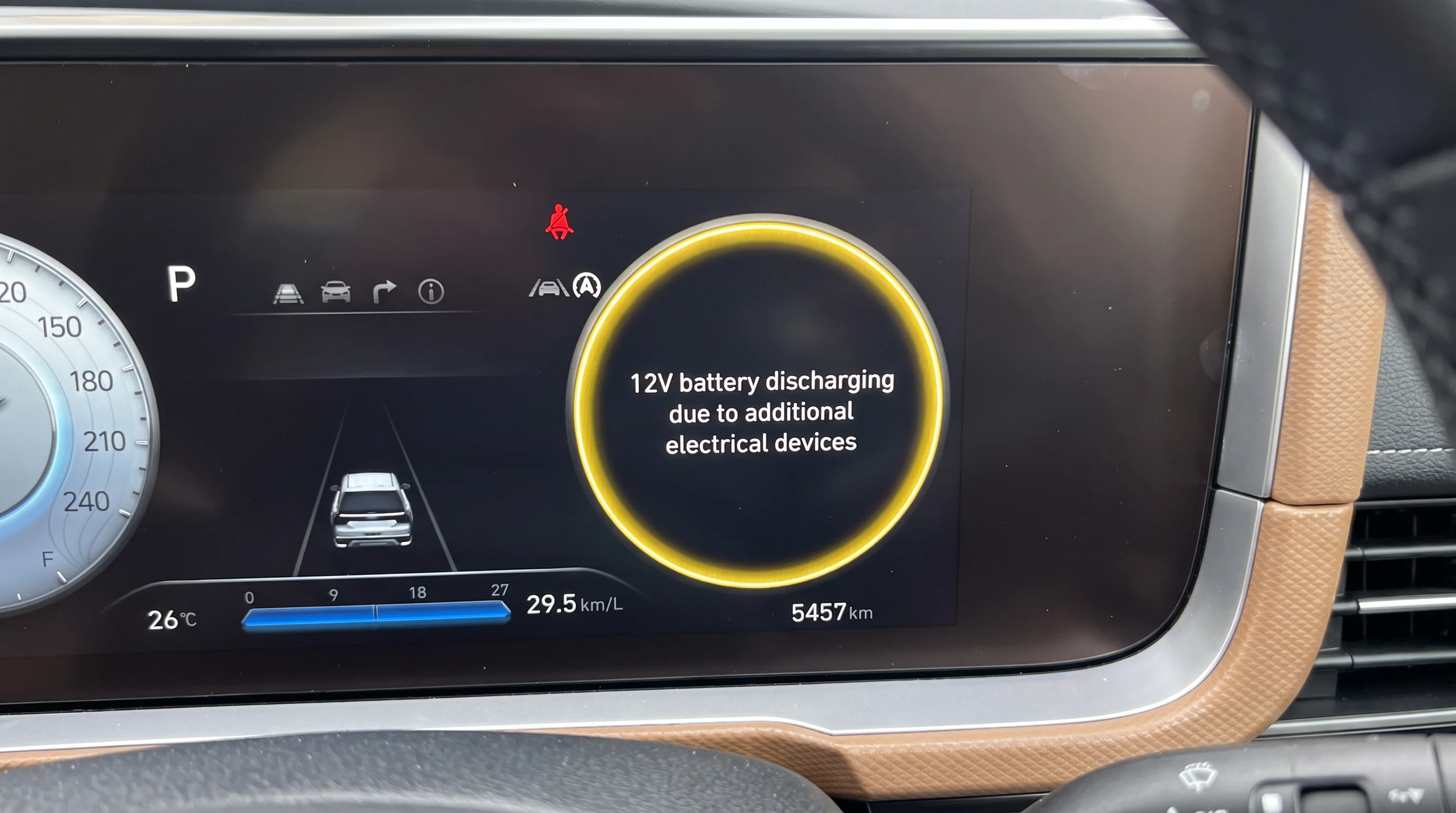
The Hyundai battery discharge warning means your vehicle’s 12-volt battery is running low or losing charge. According to Hyundai’s owner’s manual, the message appears when the battery voltage is low or when the vehicle detects a power draw that could drain it. In most cases, the cause is simple. Electrical accessories are running while the engine is off.
Hyundai uses different wording depending on the model and year. Here is what each message means and what to do next.
| Message | When It Appears | What to Do |
|---|---|---|
| “Battery discharging due to external electrical devices” (some models: “12V battery discharging due to additional electrical devices”) | The 12-volt battery voltage is low, or the vehicle detects a current draw that could drain the battery. | Disconnect external electronic devices. If none are connected, have an authorized Hyundai dealer inspect the vehicle. |
| Battery warning while using the infotainment system with the engine off | The infotainment system is in use while the engine is stopped. | Start the engine. Hyundai advises using the system with the engine running. |
| “Start engine to avoid battery discharge” (hybrid models) | The vehicle is switched ON, but the READY indicator is not lit. | Switch the vehicle to READY mode. |
The 12-volt battery does more than start the engine. Hyundai describes it as the power supply for systems such as the lamps, wipers, and audio system. In hybrid models, Hyundai notes the hybrid system may not operate when the 12-volt battery is discharged.
If the warning keeps coming back, call our service team at 888-348-4964 or visit us at 1307 Kettering Dr in Ontario.
Not necessarily. The warning is a safeguard, not a sign that the battery has failed. Hyundai’s infotainment manual cautions that using the system for a long time with the engine stopped may discharge the battery. The general-market edition adds that the battery warning disappears once the engine starts.
If the message clears after you start the vehicle and stays off during normal driving, it was most likely responding to accessory use.
A warning that keeps returning is a different story. Hyundai’s manual also offers a simple check. If the interior light dims or goes out when you operate the starter, the battery is drained. In that case, have the battery tested.
Parasitic drain happens when a component keeps drawing power from the 12-volt battery after the vehicle is shut off. The battery then loses charge while the car sits parked. Two common triggers come straight from Hyundai’s guidance.
Hyundai’s owner’s manual warns not to connect external electronic devices to the battery system, because they can discharge it. Hyundai’s battery care guidance adds that aftermarket plug-in devices can keep drawing power even when the car is not running.
According to Hyundai, the vehicle battery may be discharged if the smart key is left near the vehicle. Store your keys away from the parked car, especially overnight.
Electric Hyundai models such as the IONIQ 5 add another layer of protection. Aux. Battery Saver+ uses the high-voltage battery to recharge the 12-volt battery between drives. It does have limits. Hyundai notes that it cannot prevent a discharge if unauthorized electronic devices are drawing power or the 12-volt battery is damaged or worn out. It also cannot help if the vehicle has not been driven or charged for an extended time. For more EV-specific tips, read our IONIQ 5 and IONIQ 9 summer battery care guide.
To clear the engine-off warning, start the engine, or put a hybrid Hyundai into READY mode. Then remove whatever is draining the battery and give it time to recharge.
If the 12-volt battery is too low to power on the vehicle, jump-start it by following your owner’s manual. Hyundai’s procedure connects the cables to the designated jumper terminals under the hood, in a set order. If the cause of the discharge isn’t clear afterward, Hyundai recommends having the vehicle checked by an authorized Hyundai dealer.
The information in this article is general guidance and does not constitute a specific diagnostic or repair recommendation for any individual vehicle. Repair and maintenance decisions should be made in consultation with a certified technician based on the specific condition of your vehicle.
Sometimes the warning keeps returning even after you unplug add-on electronics and move your smart key away from the car. In that case, everyday accessory use is probably not the only cause.
Hyundai’s owner’s manual is direct about this. If the external electrical devices message appears and no external devices are connected, have the vehicle inspected by an authorized Hyundai dealer. Common contributors include:
The information in this article is general guidance and does not constitute a specific diagnostic or repair recommendation for any individual vehicle. Repair and maintenance decisions should be made in consultation with a certified technician based on the specific condition of your vehicle.
If a dead battery leaves you stranded, call Hyundai 24-Hour Roadside Assistance at 1-800-243-7766. Here is how Hyundai’s factory coverage applies, per the 2026 Owner’s Handbook & Warranty Information and America’s Best Warranty.
| Coverage | Term | What It Covers |
|---|---|---|
| 24-Hour Roadside Assistance | 5 years / unlimited miles | Starts on the date of first retail delivery or the in-service date, whichever is earlier. Call 1-800-243-7766. |
| Original-equipment 12-volt battery (New Vehicle Limited Warranty) | 3 years / 36,000 miles | A defect in material or workmanship, whichever limit comes first. Applies to the standard 12-volt battery, not hybrid or EV batteries. |
| Hybrid / Electric battery | 10 years / 100,000 miles | Covered separately from the 12-volt battery. |
| Powertrain Limited Warranty | 10 years / 100,000 miles | Original owner only. Not transferable to later owners. |
This information is provided for general educational purposes only and does not constitute legal advice. Warranty coverage depends on the specific terms of your vehicle’s warranty agreement. Consult your owner’s manual or a qualified legal professional for guidance on your individual situation.
Hyundai doesn’t publish a fixed time. Its infotainment manual cautions that using the system for a long time with the engine stopped may discharge the battery. Hyundai advises using the system with the engine running.
No. The battery discharge warning relates to the 12-volt battery, not the high-voltage hybrid or EV battery. Hyundai uses separate messages for the hybrid battery. However, Hyundai notes the hybrid system may not operate when the 12-volt battery is discharged.
Yes. Hyundai’s owner’s manual states that the vehicle battery may be discharged if the smart key is left near the vehicle. Keep your keys away from the parked vehicle overnight.
Starting the engine clears the engine-off warning, but fully recharging a depleted battery takes longer. After a jump start, Hyundai’s owner’s manual calls for at least 30 minutes of idling or driving. A completely discharged battery may need up to 60 minutes.
Yes, if the battery is defective. Hyundai’s 2026 Owner’s Handbook & Warranty Information covers an original-equipment 12-volt battery found defective in material or workmanship for 3 years or 36,000 miles, whichever occurs first. Hybrid and EV batteries are covered separately for 10 years or 100,000 miles. The Powertrain Limited Warranty runs 10 years or 100,000 miles for the original owner only.
This information is provided for general educational purposes only and does not constitute legal advice. Warranty coverage depends on the specific terms of your vehicle’s warranty agreement. Consult your owner’s manual or a qualified legal professional for guidance on your individual situation.
If your Hyundai keeps showing a battery discharge warning, our certified, Hyundai-trained technicians can test the battery and find the cause. If your vehicle needs a replacement 12-volt battery, we use Genuine OEM Hyundai parts.
Visit our service department at 1307 Kettering Dr in Ontario, call 888-348-4964, or schedule your appointment online.
The information in this article is general guidance and does not constitute a specific diagnostic or repair recommendation for any individual vehicle. Repair and maintenance decisions should be made in consultation with a certified technician based on the specific condition of your vehicle.
This information is provided for general educational purposes only and does not constitute legal advice. Warranty coverage depends on the specific terms of your vehicle’s warranty agreement. Consult your owner’s manual or a qualified legal professional for guidance on your individual situation.
Hyundai Elantra 2026 es un sedán compacto de cinco pasajeros pensado para familias y conductores que recorren muchas millas cada semana. La gama abarca catorce configuraciones: seis versiones de gasolina, cuatro híbridas, el deportivo Elantra N en dos transmisiones y la edición limitada Elantra N TCR. La versión híbrida Blue alcanza 54 mpg combinados EPA-estimados,…
La forma más rápida de conocer el valor de intercambio de su Hyundai es nuestra herramienta de valoración en línea. Ingrese el año, el modelo, el millaje y el estado de su vehículo para recibir una estimación basada en datos actuales del mercado. Esa cifra se ajusta según el historial de mantenimiento, el equipamiento y…
Calculating the trade-in value of your Hyundai starts with four inputs: your 17-digit vehicle identification number (VIN), your exact odometer reading, a list of factory option packages, and a valuation tool such as Kelley Blue Book or Edmunds to establish a regional baseline. The number that actually lands on your contract comes from a physical…