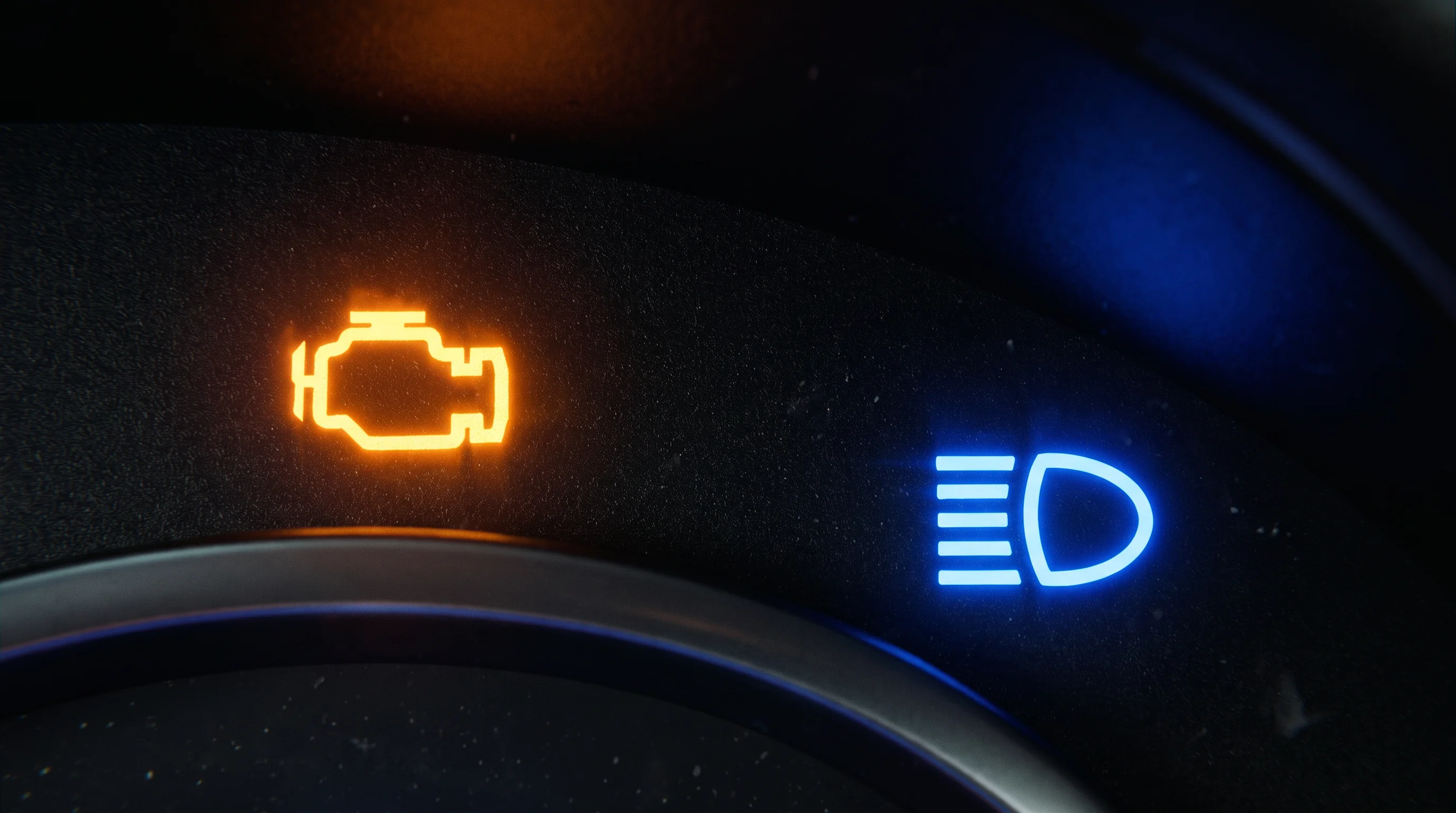
A check engine light rarely means what drivers fear it means. But it always means something. Hyundai calls it the Malfunction Indicator Lamp. It comes on when your vehicle detects a malfunction with the emission control system, the engine, or the powertrain. You might be looking at a Hyundai Elantra check engine light, a Hyundai Sonata check engine light, or a warning on another model. Either way, the first thing to determine isn’t the cause. It’s whether the light is steady or flashing. That one detail decides whether you can drive to us or need to stop where you are.
Hyundai’s guidance on a steady lamp is direct. Have the vehicle inspected by an authorized Hyundai dealer as soon as possible. Driving with the lamp on can damage the emission control system. That damage can affect drivability and fuel economy. Hyundai also warns that catalytic converter damage is possible, which can cause a loss of engine power. A steady light is not an emergency. It is also not something to drive around on indefinitely. You can read the manufacturer’s own wording in the Hyundai owner’s manual warning and indicator lights section.
Not sure whether you’re looking at the check engine light or a different warning? Our guide to the Hyundai Service Required light explains the difference. The two are commonly confused, and they mean very different things.
Two minutes of observation before you book tells our technicians a great deal. Sometimes it resolves the issue outright.
No. A flashing lamp is not a more insistent version of a steady one. It is a different signal entirely. California’s OBD II regulation requires the lamp to blink once per second when a misfire is severe enough to damage the catalyst. The system is telling you that damage is happening now. Raw gasoline is passing through the exhaust valves into a converter already at operating temperature. There it ignites, driving internal temperatures past what the substrate can survive.
If your light starts flashing:
Hyundai includes 24/7 Roadside Assistance on new vehicles for 60 months with unlimited miles. Coverage runs from the date the vehicle was delivered or first put into service, whichever is earlier. Towing takes an inoperable vehicle to the nearest Hyundai dealership or authorized service facility. The program operates in all 50 states, 365 days a year. Full terms are in the Hyundai Owner’s Handbook and Warranty Information.
A sensor reading that stays outside factory specification long enough will set a code. The engine control module stores a five-character diagnostic trouble code and turns on the lamp. The code doesn’t name the broken part. It names the circuit or system where the fault appeared. That’s why a code reading alone isn’t a diagnosis.
| Code family | System | What it typically points to |
|---|---|---|
| P0100-series | Mass airflow | A dirty or failing MAF sensor misreading incoming air volume |
| P0130-series | Oxygen sensors | An upstream or downstream O2 sensor circuit fault |
| P0171 / P0172 | Fuel trim | A mixture running too lean (P0171) or too rich (P0172) |
| P0300-series | Misfire | Combustion failure — P0300 is a random misfire, while P0301 onward identify the affected cylinder |
| P0420 | Catalyst efficiency | Catalyst system efficiency below threshold on Bank 1 |
| P0440-series | Evaporative emissions | A vapor leak at the fuel cap, purge valve, or charcoal canister |
A stored P0300 confirms a misfire. It does not tell you whether the cause is a worn spark plug, a weak ignition coil, low fuel pressure, or a valve sealing problem. Narrowing that down is what a dealership diagnostic does.
The evaporative emissions system checks itself by pressurizing or drawing a vacuum on the fuel tank. A cap that’s cracked, dirty on the sealing surface, or simply loose registers as a leak. Under California’s OBD II regulation, a fault is typically confirmed and stored on the second driving cycle in which the system detects it. That is why the lamp sometimes appears a day or two after the problem starts.
Tightening the cap fixes the cause. It won’t turn the light off right away. The module has to complete its self-checks without seeing the fault again before it clears the lamp on its own. How long that takes depends on which monitor is involved and how the vehicle is driven. A mix of city and highway driving over several trips is usually enough. If the light is still on after a week of normal driving, the cap wasn’t the problem.
This is the question most drivers actually want answered. For a check engine light, the answer is better than most people expect. The components that most often trigger the lamp are named directly in Hyundai’s emission warranty.
| Coverage | Term | Why it matters for a check engine light |
|---|---|---|
| New Vehicle Limited Warranty | 5 years / 60,000 miles | Covers most originally installed components found defective in material or workmanship |
| Powertrain Limited Warranty | 10 years / 100,000 miles, original owner only | Engine and transmission internals; subsequent owners are covered 5 years / 60,000 miles instead |
| Federal Emission Warranty — major components | 8 years / 80,000 miles | Covers the catalytic converter, the engine control module including the onboard emissions diagnostic device, and the exhaust manifold catalytic assembly |
| California Emission Control System Warranty | 5 years / 60,000 miles, with 7/70 and 8/80 coverage on specific parts | Applies to vehicles registered in California, where Ontario Hyundai customers register their vehicles |
Hyundai publishes a parts list for its federal emission warranty. Nearly every component behind a common check engine light appears on it.
| Component | Federal emission warranty coverage | Related code family |
|---|---|---|
| Catalytic converter | 8 years / 80,000 miles | P0420 |
| Exhaust manifold catalytic assembly | 8 years / 80,000 miles | P0420 |
| Engine control module, including the onboard emissions diagnostic device | 8 years / 80,000 miles | Any — this is the module that sets the codes |
| Oxygen sensor | 5 years / 60,000 miles | P0130-series |
| Air flow sensor | 5 years / 60,000 miles | P0100-series |
| Ignition coil assembly | 5 years / 60,000 miles | P0300-series |
| Fuel injectors | 5 years / 60,000 miles | P0300-series |
| Spark plugs and ignition wires | 5 years / 60,000 miles, or until the first scheduled replacement interval, whichever comes first | P0300-series |
| Canister assembly and purge control valve | 5 years / 60,000 miles | P0440-series |
| Fuel filler cap | 5 years / 60,000 miles | P0440-series |
| Malfunction Indicator Lamp and bulb | 5 years / 60,000 miles | Not code-driven — this is the lamp itself |
Vehicles registered in California carry 7-year / 70,000-mile coverage on certain additional parts, and the list varies by model and engine. The complete parts lists appear in the Hyundai Owner’s Handbook and Warranty Information.
For California-registered vehicles, Hyundai’s language is explicit. Where a warrantable condition exists, the repair is performed at no cost to you. That includes diagnosis, parts, and labor. The exclusion is just as clear. Diagnostic labor that does not lead to finding a warrantable condition is not covered.
In practice, that means two very different outcomes. A check engine light traced to a covered emission component is likely to cost you nothing. One traced to an unseated gas cap, an aftermarket modification, external damage, or a normal wear item is your responsibility.
Coverage depends on your vehicle’s age, mileage, and what the scan actually finds. The only way to know is to have it diagnosed. Contact our service department for current diagnostic pricing and to confirm your remaining coverage.
This information is provided for general educational purposes only and does not constitute legal advice. Warranty coverage depends on the specific terms of your vehicle’s warranty agreement. Consult your owner’s manual or a qualified legal professional for guidance on your individual situation.
A free code reading at a parts counter pulls the stored code and stops there. That’s a starting point, not an answer. A dealership diagnostic works the code back to the component.
Reading active, pending, and historical trouble codes from module memory.
Examining the engine speed, coolant temperature, fuel trim, and vehicle speed recorded at the moment the code set.
Watching real-time sensor signals with the engine running to confirm what each circuit is reporting.
Testing wiring, connectors, vacuum lines, and continuity.
Freeze-frame data is what makes intermittent faults findable. The module captures operating conditions at the instant the fault occurred. A technician can then reproduce those conditions on a test drive instead of guessing.
The information in this article is general guidance and does not constitute a specific diagnostic or repair recommendation for any individual vehicle. Repair and maintenance decisions should be made in consultation with a certified technician based on the specific condition of your vehicle.
Usually, yes. Once the underlying fault is resolved, the engine control module turns the lamp off on its own. It does this after enough fault-free self-checks to confirm the repair held. How many trips that takes depends on which monitor is involved. A technician can also clear stored codes directly with diagnostic equipment.
A battery or charging system problem has its own dedicated indicator. Hyundai’s 12V battery charging system warning light illuminates when there is a malfunction with the alternator or electrical charging system. If you are seeing a battery-related warning rather than the check engine light, our guide to the Hyundai Battery Discharge Warning covers what that means. Testing battery state of health and charging system output is worth doing before replacing powertrain sensors in any case.
Yes, when the underlying failure is a covered component. Hyundai’s California emission warranty states that where a warrantable condition exists, the vehicle is repaired at no cost including diagnosis, parts, and labor. If the scan determines the lamp was triggered by something non-warrantable, testing fees are the owner’s responsibility. That includes an unseated gas cap, aftermarket modifications, external damage, or a normal wear item.
This information is provided for general educational purposes only and does not constitute legal advice. Warranty coverage depends on the specific terms of your vehicle’s warranty agreement. Consult your owner’s manual or a qualified legal professional for guidance on your individual situation.
It is a snapshot of operating conditions. The engine control module records it automatically at the moment a trouble code sets. The snapshot includes engine speed, coolant temperature, vehicle speed, intake pressure, and fuel trim values. Technicians use it to recreate the conditions that produced the fault. That is often the only practical way to diagnose an intermittent problem.
Significantly. When an oxygen sensor stops reporting accurately, the control module loses its feedback signal. It then defaults to a richer fuel mixture to protect the engine, burning more fuel continuously. The CarMD 2026 Vehicle Health Index analyzed more than 39 million U.S. vehicles. It found that ignoring a failing oxygen sensor can reduce fuel economy by as much as 40%, even when the vehicle seems to be driving normally. A failing sensor also accelerates wear on the catalytic converter, a far more expensive component.
Our factory-trained technicians diagnose check engine lights using Hyundai diagnostic equipment and genuine Hyundai parts. We serve drivers across Ontario, Fontana, and Rancho Cucamonga. Whether your light is steady or flashing, getting the code read properly turns an unknown into a known.
Visit our service department at 1307 Kettering Dr, Ontario, CA 91761. Call 888-348-4964, or book online. For other maintenance questions, see our Hyundai maintenance schedules guide or browse all of our service and parts tips.
The information in this article is general guidance and does not constitute a specific diagnostic or repair recommendation for any individual vehicle. Repair and maintenance decisions should be made in consultation with a certified technician based on the specific condition of your vehicle.
This information is provided for general educational purposes only and does not constitute legal advice. Warranty coverage depends on the specific terms of your vehicle’s warranty agreement. Consult your owner’s manual or a qualified legal professional for guidance on your individual situation.
Hyundai Elantra 2026 es un sedán compacto de cinco pasajeros pensado para familias y conductores que recorren muchas millas cada semana. La gama abarca catorce configuraciones: seis versiones de gasolina, cuatro híbridas, el deportivo Elantra N en dos transmisiones y la edición limitada Elantra N TCR. La versión híbrida Blue alcanza 54 mpg combinados EPA-estimados,…
La forma más rápida de conocer el valor de intercambio de su Hyundai es nuestra herramienta de valoración en línea. Ingrese el año, el modelo, el millaje y el estado de su vehículo para recibir una estimación basada en datos actuales del mercado. Esa cifra se ajusta según el historial de mantenimiento, el equipamiento y…
Calculating the trade-in value of your Hyundai starts with four inputs: your 17-digit vehicle identification number (VIN), your exact odometer reading, a list of factory option packages, and a valuation tool such as Kelley Blue Book or Edmunds to establish a regional baseline. The number that actually lands on your contract comes from a physical…