



2026 Hyundai Palisade Hybrid vs. Gas: EPA-Estimated MPG, Towing and Value Compared
The 2026 Hyundai Palisade Hybrid earns up to an EPA-estimated 33 mpg city, 35 mpg highway and 34 mpg combined. The gas 3.5-liter V6 is rated at an EPA-estimated 19 mpg city, 25 mpg highway and 21 mpg combined with front-wheel drive. At the top of each range, that is a 13 mpg combined advantage for the Hybrid.
Towing runs the other way. Properly equipped with trailer brakes, the gas V6 is rated for 5,000 pounds. The Hybrid is rated for 4,000 pounds.
Both powertrains seat up to eight. Both carry the same cargo volume. Both share the same standard driver-assistance suite. So the decision comes down to how you actually use the vehicle. High-mileage commuters gain the most from the Hybrid. Families who tow near the top of the range should stay with the V6.
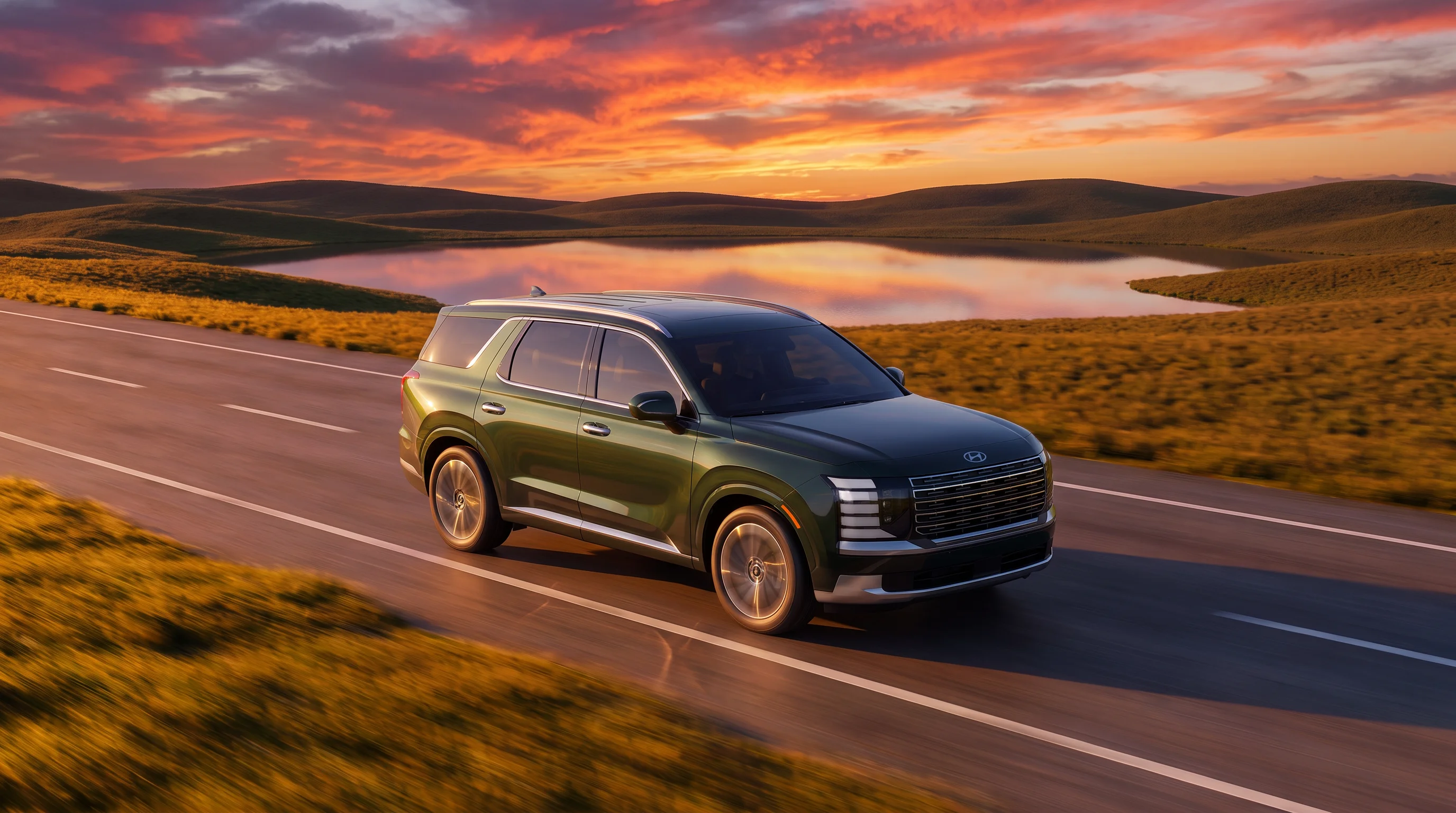
How the Two 2026 Palisade Powertrains Are Built
The Gas 3.5-Liter V6
The gas model uses a naturally aspirated 3.5-liter V6. It produces 287 horsepower at 6,400 rpm and 260 lb-ft of torque at 5,000 rpm. Power runs through an eight-speed automatic transmission.
The Hybrid 2.5-Liter Turbo
The Hybrid pairs a 2.5-liter turbocharged inline-four with two electric motors. Combined output is 329 horsepower and 339 lb-ft of torque. A six-speed automatic transmission handles the shifting.
That transmission choice matters more than the spec sheet suggests. Hyundai builds both electric motors directly into a conventional six-speed automatic. There is no continuously variable transmission. So the Hybrid pulls away from a stop on immediate electric torque, then shifts through fixed gears instead of droning. A 1.65 kWh lithium-ion battery feeds the electric side. It recharges itself through regenerative braking and engine load.
Drivetrain and the XRT Pro
Front-wheel drive is standard on most trims. Hyundai’s HTRAC all-wheel drive is available across the lineup. It is standard on the off-road-oriented XRT Pro, which is a gas-only trim.
The XRT Pro also carries 8.4 inches of minimum ground clearance, against 7.4 inches on other trims. It adds an electronic limited-slip differential and all-terrain tires. Terrain Mode Select, with Mud, Sand and Snow settings, comes on every all-wheel-drive model. It is not exclusive to the XRT Pro. For a broader look at the redesign, see our 2026 Hyundai Palisade overview.
EPA-Estimated Fuel Economy: Where the Gap Actually Falls
Fuel economy varies by trim and drivetrain more than most comparisons admit. Quote one number for either powertrain and you understate the Hybrid’s best case. Hyundai publishes six distinct EPA-estimated ratings across the 2026 Palisade lineup.
| Configuration | EPA-Estimated City | EPA-Estimated Highway | EPA-Estimated Combined |
|---|---|---|---|
| Hybrid Blue SEL / Blue SEL Premium (FWD) | 33 mpg | 35 mpg | 34 mpg |
| Hybrid Limited / Calligraphy (FWD) | 31 mpg | 32 mpg | 31 mpg |
| Hybrid, all trims (HTRAC AWD) | 29 mpg | 30 mpg | 29 mpg |
| Gas 3.5L V6 (FWD) | 19 mpg | 25 mpg | 21 mpg |
| Gas 3.5L V6 (HTRAC AWD) | 18 mpg | 24 mpg | 20 mpg |
| Gas 3.5L V6, XRT Pro (AWD, gas-only trim) | 16 mpg | 22 mpg | 19 mpg |
EPA-estimated fuel economy figures are for comparison purposes only. Your actual mileage will vary depending on driving conditions, how you drive and maintain your vehicle, battery age/condition, and other factors.
What the Numbers Mean by Trim
The pattern is straightforward. The Hybrid’s most efficient versions are the front-wheel-drive Blue SEL and Blue SEL Premium. Both ride on 18-inch wheels. Step up to the larger wheels on Limited and Calligraphy and the EPA-estimated combined rating drops by three mpg. Add HTRAC all-wheel drive and every Hybrid trim lands at an EPA-estimated 29 mpg combined.
So the all-wheel-drive penalty on the Hybrid costs between two and five mpg on the EPA-estimated combined rating, depending on where you start. That is a wider spread than is commonly quoted. Our Palisade Hybrid MPG and trim breakdown walks through each configuration in detail.
On the gas side, front-wheel-drive models return an EPA-estimated 21 mpg combined. All-wheel-drive models return 20 mpg combined. The XRT Pro is the exception. Its standard all-wheel drive, taller stance and all-terrain tires drop it to an EPA-estimated 19 mpg combined, the lowest in the lineup.
Driving Range Between Fill-Ups
Range follows the same logic. The Hybrid carries an 18.2-gallon tank. The gas V6 carries a 19.0-gallon tank.
Hyundai estimates up to 619 miles of range for the Hybrid Blue SEL and Blue SEL Premium with front-wheel drive. That figure is based on a full tank and their EPA-estimated 34 mpg combined rating. Estimated ranges for other trims vary.
For daily driving around Ontario, Fontana and Rancho Cucamonga, the Hybrid’s advantage concentrates in stop-and-go conditions. The electric motors handle low-speed movement. Regenerative braking recovers energy that a conventional engine would send out as heat. That is why the Hybrid’s city rating sits above its highway rating on every configuration. Shoppers weighing a smaller three-row alternative can also review Hyundai Santa Fe Hybrid fuel economy.
EPA-estimated fuel economy figures are for comparison purposes only. Your actual mileage will vary depending on driving conditions, how you drive and maintain your vehicle, battery age/condition, and other factors.
Towing and Cargo: Where the Gas V6 Pulls Ahead
If maximum towing capability is your priority, the gas V6 is the answer. Properly equipped with trailer brakes, gas models tow up to 5,000 pounds. The Hybrid tows up to 4,000 pounds under the same conditions. Without trailer brakes, both are limited to 1,650 pounds.
| Specification | Palisade Gas 3.5L V6 | Palisade Hybrid 2.5T |
|---|---|---|
| Engine | 3.5-liter naturally aspirated V6 | 2.5-liter turbocharged inline-4 with two electric motors |
| Horsepower | 287 hp at 6,400 rpm | 329 hp combined |
| Torque | 260 lb-ft at 5,000 rpm | 339 lb-ft combined |
| Transmission | 8-speed automatic | 6-speed automatic |
| Drivetrain | FWD standard, HTRAC AWD available and standard on XRT Pro | FWD standard, HTRAC AWD available |
| Best EPA-Estimated Combined MPG | 21 mpg | 34 mpg |
| Maximum Towing (with trailer brakes) | 5,000 lbs | 4,000 lbs |
| Maximum Towing (without trailer brakes) | 1,650 lbs | 1,650 lbs |
| Fuel Tank | 19.0 gallons | 18.2 gallons |
| Hybrid Battery | None, gasoline power only | 1.65 kWh lithium-ion |
| Maximum Seating | 8 passengers | 8 passengers |
Powertrain, capacity and dimension figures above are drawn from Hyundai’s published 2026 Palisade Features and Specifications.
Maximum towing and payload capacity figures are based on properly equipped vehicles and vary by configuration. Do not exceed any weight rating. See your owner’s manual and the vehicle’s door-jamb label for specific capacities.
Towing Equipment Is the Same on Both
The equipment story is more even than the ratings suggest. Every 2026 Palisade includes the trailering package as standard, regardless of powertrain. That package covers trailer pre-wiring, heavy-duty engine and transmission coolers, and Trailer Sway Control.
A factory-installed tow hitch is standard on the XRT Pro, Limited and Calligraphy trims. Other trims can add it as an accessory. Tow Mode holds lower gears longer on grades, and it is standard on all-wheel-drive models of both the Hybrid and the gas V6.
Cargo Space Is Identical
Cargo capacity does not change between the two powertrains. Hyundai packages the hybrid battery below the floor, so it never intrudes into the cargo area.
19.1 Cubic Feet
Behind the third row
46.3 Cubic Feet
Behind the second row
86.7 Cubic Feet
Behind the front seats
Interior volume is not quite identical. The gas model measures 181.0 cubic feet of total interior volume. The Hybrid measures 178.7. Second-row legroom is 43.0 inches in the gas model and 41.4 inches in the Hybrid. The difference shows up in the second row, not the cargo hold.
Long-Term Value: Which Palisade Costs Less to Own
Fuel Cost Over Time
The gas V6 carries the lower starting price of the two powertrains. The Hybrid commands a premium over comparably equipped gas trims. Whether that premium pays back depends almost entirely on annual mileage.
At 12,000 to 15,000 miles a year, the gap compounds quickly between a gas Palisade at an EPA-estimated 21 mpg combined and a Hybrid Blue SEL at an EPA-estimated 34 mpg combined. Drive substantially less than that and the payback period stretches out. At that point the gas V6 becomes the more sensible purchase.
There is a second, quieter saving. Regenerative braking does a share of the deceleration work in the Hybrid. That tends to reduce wear on conventional friction brakes over time.
Warranty Coverage
Hyundai’s factory coverage is the same on both powertrains, with one addition unique to the Hybrid.
| Coverage | Palisade Gas 3.5L V6 | Palisade Hybrid 2.5T |
|---|---|---|
| New Vehicle Limited Warranty | 5 years / 60,000 miles | 5 years / 60,000 miles |
| Powertrain Warranty (original owner) | 10 years / 100,000 miles | 10 years / 100,000 miles |
| Hybrid System Components | Not applicable, no hybrid system fitted | 10 years / 100,000 miles |
| Anti-Perforation (rust) | 7 years / unlimited miles | 7 years / unlimited miles |
| Roadside Assistance | 5 years / unlimited miles | 5 years / unlimited miles |
This information is provided for general educational purposes only and does not constitute legal advice. Warranty coverage depends on the specific terms of your vehicle’s warranty agreement. Consult your owner’s manual or a qualified legal professional for guidance on your individual situation.
Standard Safety and Technology
Standard equipment does not vary by fuel type. Where content differs, it tracks trim level instead. Here is what every 2026 Palisade includes.
| Feature | Availability |
|---|---|
| Forward Collision-Avoidance Assist | Standard on all trims |
| Lane Keeping Assist and Lane Following Assist | Standard on all trims |
| Blind-Spot Collision Warning | Standard on all trims |
| Rear Cross-Traffic Collision-Avoidance Assist | Standard on all trims |
| Navigation-based Smart Cruise Control with Stop and Go | Standard on all trims |
| Highway Driving Assist | Standard on all trims |
| 12.3-inch touchscreen with navigation | Standard on all trims |
| Wireless Apple CarPlay and Android Auto | Standard on all trims |
| 12.3-inch digital instrument cluster | Standard from SEL upward; SE uses a 4.2-inch cluster display |
Driver-assistance and advanced safety systems are supplemental aids and are not substitutes for safe and attentive driving. Availability, operation, and effectiveness vary by trim and equipment and depend on factors including road, weather, traffic, and vehicle condition. Always keep your hands on the wheel and your eyes on the road. See your owner’s manual for system limitations and details.
The Verdict: Which 2026 Palisade Fits Your Driving
Neither powertrain wins outright. Each takes specific categories. The right choice follows from which categories matter to your household.
| Category | Winner | Why |
|---|---|---|
| EPA-Estimated Fuel Economy | Hybrid | Up to 34 mpg combined against 21 mpg combined for the gas V6 with front-wheel drive |
| Maximum Towing | Gas V6 | 5,000 lbs against 4,000 lbs, both with trailer brakes |
| Power Output | Hybrid | 329 hp and 339 lb-ft combined against 287 hp and 260 lb-ft |
| Entry Price | Gas V6 | Lower starting price than comparably equipped Hybrid trims |
| Cargo Capacity | Tie | Identical at 19.1, 46.3 and 86.7 cubic feet |
| Off-Road Capability | Gas V6 | XRT Pro is a gas-only trim with 8.4 inches of ground clearance and an electronic limited-slip differential |
| Driving Range | Hybrid | Up to 619 miles on the Blue SEL and Blue SEL Premium with front-wheel drive |
| Warranty Coverage | Hybrid | Same terms as the gas V6, plus 10 years / 100,000 miles on hybrid system components |
Choose the Hybrid If
You commute daily. You drive more than 12,000 miles a year. You spend most of your time in stop-and-go traffic. And you tow either nothing or a light single-axle trailer.
Choose the Gas V6 If
You want the lowest entry price. You tow near the 5,000-pound ceiling. You want the XRT Pro’s off-road hardware. Or you drive low annual mileage, where fuel savings never get the chance to compound.
Common Questions About the 2026 Palisade Powertrains
Does the 2026 Hyundai Palisade Hybrid require an external plug or charging station?
No. The 2026 Palisade Hybrid is a conventional self-charging hybrid that does not require an electrical outlet or wall charger. Its 1.65 kWh lithium-ion battery recharges automatically through regenerative braking and energy produced by the turbocharged gas engine during everyday driving.
What is the estimated driving range of the 2026 Palisade Hybrid?
Hyundai estimates up to 619 miles of driving range for the Hybrid Blue SEL and Blue SEL Premium front-wheel-drive models, based on an 18.2-gallon tank and their EPA-estimated 34 combined mpg rating. Estimated ranges for other trims vary.
Are safety features different between the gas and hybrid Palisade models?
Standard driver-assistance content does not vary by powertrain. Every 2026 Palisade includes Forward Collision-Avoidance Assist, Lane Keeping Assist, Lane Following Assist and Blind-Spot Collision Warning as standard equipment, with Navigation-based Smart Cruise Control with Stop and Go and Highway Driving Assist also standard. Equipment differences track trim level rather than fuel type.
Does the hybrid battery reduce cargo space in the Palisade?
Cargo volume is identical between the gas and hybrid versions because the hybrid battery is packaged beneath the vehicle floor. Both provide 19.1 cubic feet behind the third row and 86.7 cubic feet behind the front seats. Total interior volume differs slightly, at 181.0 cubic feet for the gas model and 178.7 for the Hybrid.
Which 2026 Palisade trims come standard with a factory trailer hitch?
The XRT Pro, Limited and Calligraphy trims come equipped with a factory-installed tow hitch. Other trims can be fitted with the hitch as an accessory. Trailer pre-wiring and Trailer Sway Control are standard on every trim.
Does the Palisade Hybrid come with extra warranty coverage?
Yes. The Hybrid carries the same 5-year/60,000-mile limited warranty and 10-year/100,000-mile powertrain warranty as the gas V6. It adds 10-year/100,000-mile coverage on hybrid system components.
Compare Both 2026 Palisade Powertrains in Ontario
Specifications answer part of the question. The rest you feel from the driver’s seat, in the difference between the V6’s linear pull and the Hybrid’s immediate low-end torque.
Our team can walk you through both powertrains, show you how trim selection changes the fuel economy figures above, and help you land on the right configuration for your family. More model guides are available in our Hyundai research library.
Disclaimers
EPA-estimated fuel economy figures are for comparison purposes only. Your actual mileage will vary depending on driving conditions, how you drive and maintain your vehicle, battery age/condition, and other factors.
Maximum towing and payload capacity figures are based on properly equipped vehicles and vary by configuration. Do not exceed any weight rating. See your owner’s manual and the vehicle’s door-jamb label for specific capacities.
This information is provided for general educational purposes only and does not constitute legal advice. Warranty coverage depends on the specific terms of your vehicle’s warranty agreement. Consult your owner’s manual or a qualified legal professional for guidance on your individual situation.
Driver-assistance and advanced safety systems are supplemental aids and are not substitutes for safe and attentive driving. Availability, operation, and effectiveness vary by trim and equipment and depend on factors including road, weather, traffic, and vehicle condition. Always keep your hands on the wheel and your eyes on the road. See your owner’s manual for system limitations and details.